
Sheet Metal Fabrication in NJ: Methods, Benefits, and Industry Applications
From skyscraper frames to surgical instruments, sheet metal fabrication underpins nearly every sector of modern industry. This process transforms flat metal sheets into functional, precision components that power aerospace systems, medical devices, industrial enclosures, and everyday consumer products. In New Jersey — one of the Northeast’s most concentrated manufacturing regions — sheet metal fabrication remains essential to innovation, supply chain resilience, and product reliability.
At facilities such as DureX Inc. in Union, NJ, engineers collaborate directly with production teams to translate 3D models into manufacturable parts that meet strict tolerance, performance, and finish requirements — all without the delays or risks associated with offshore supply chains.
Capabilities at a Glance
When evaluating a fabrication partner, engineers and procurement managers need quick access to technical specifications. Below is a summary of DureX’s core services, materials, and precision standards:
Service | Material | Max Thickness / Capacity | Precision / Tolerance |
|---|---|---|---|
Laser Cutting | Stainless / Carbon / Aluminum | Up to 1.0″ (varies by material) | ± 0.005″ |
CNC Bending | All Sheet Alloys | 12′ length / 250 Tons | Repeatable ± 1° |
Stamping | Steel, Aluminum, Galvanneal | High-volume runs (10k+ units) | Die-matched tolerances |
MIG / TIG Welding | Steel, Stainless, Aluminum | All gauges | AWS Certified welds |
Robotic Welding | Steel, Stainless | High-volume repetition | Consistent seam quality |
Powder Coating | All metals | Full enclosures to small parts | Uniform finish, chip-resistant |
Materials We Work With
Specifying the right alloy is critical to performance, cost, and longevity. DureX fabricates from a broad range of materials — including specialty alloys that drive long-tail search queries from engineers sourcing specific grades:
Material / Alloy | Common Applications |
|---|---|
Cold Rolled Steel | General fabrication, enclosures, brackets |
Stainless Steel 304 / 316 / 430 | Medical, food-grade, corrosion-resistant applications |
Aluminum 1100 / 3003 / 5052 / 6061 | Aerospace, electronics, lightweight structural parts |
Galvanneal / Galvanized Steel | Construction, HVAC, outdoor applications |
Copper and Brass | Electrical components, decorative hardware |
Need a Quote for a NJ Fabrication Project? Upload Your CAD Files at durexinc.com |

What Is Sheet Metal Fabrication?
Sheet metal fabrication refers to the process of forming metal sheets — typically steel, aluminum, or stainless steel — into desired shapes and structures through techniques such as cutting, bending, stamping, and welding. These methods convert raw materials into durable components that can withstand mechanical stress, corrosion, and environmental exposure.
Fabrication now encompasses a full lifecycle approach that includes computer-aided design (CAD), laser-based cutting, automated bending, robotic welding, and powder-coated finishing — each step linked through digital manufacturing controls.
In a regional context, sheet metal fabrication in NJ benefits from a dense network of OEMs, transportation infrastructure, and skilled labor. Facilities in Union, Newark, and Edison operate within driving distance of both New York City and major Northeast distribution routes, giving local manufacturers a speed advantage when prototyping or scaling new products.
Full-Service Sheet Metal Fabrication Serving New Jersey & The Tri-State Area
DureX Inc. provides full-service metal fabrication to manufacturers across Union, Essex, Bergen, Hudson, and Middlesex counties — and throughout the broader Tri-State area. Our proximity to Newark, the Port of Newark, and New York City allows us to respond rapidly to engineering changes, deliver same-day or next-day to regional clients, and support lean manufacturing schedules that multi-vendor or offshore setups simply cannot match.
Whether you’re a startup in Jersey City prototyping your first enclosure or an established OEM in Parsippany scaling to 50,000 units, DureX’s integrated facility in Union, NJ delivers the speed, precision, and accountability you need — without the risk of changing suppliers at each production stage.
Fabrication Methods Explained
Sheet metal fabrication combines multiple forming and joining techniques to produce components that are accurate, strong, and ready for assembly. At DureX, fabrication workflows integrate cutting, forming, machining, and finishing into a seamless production cycle — eliminating multi-vendor coordination and shortening lead times.
Laser Cutting
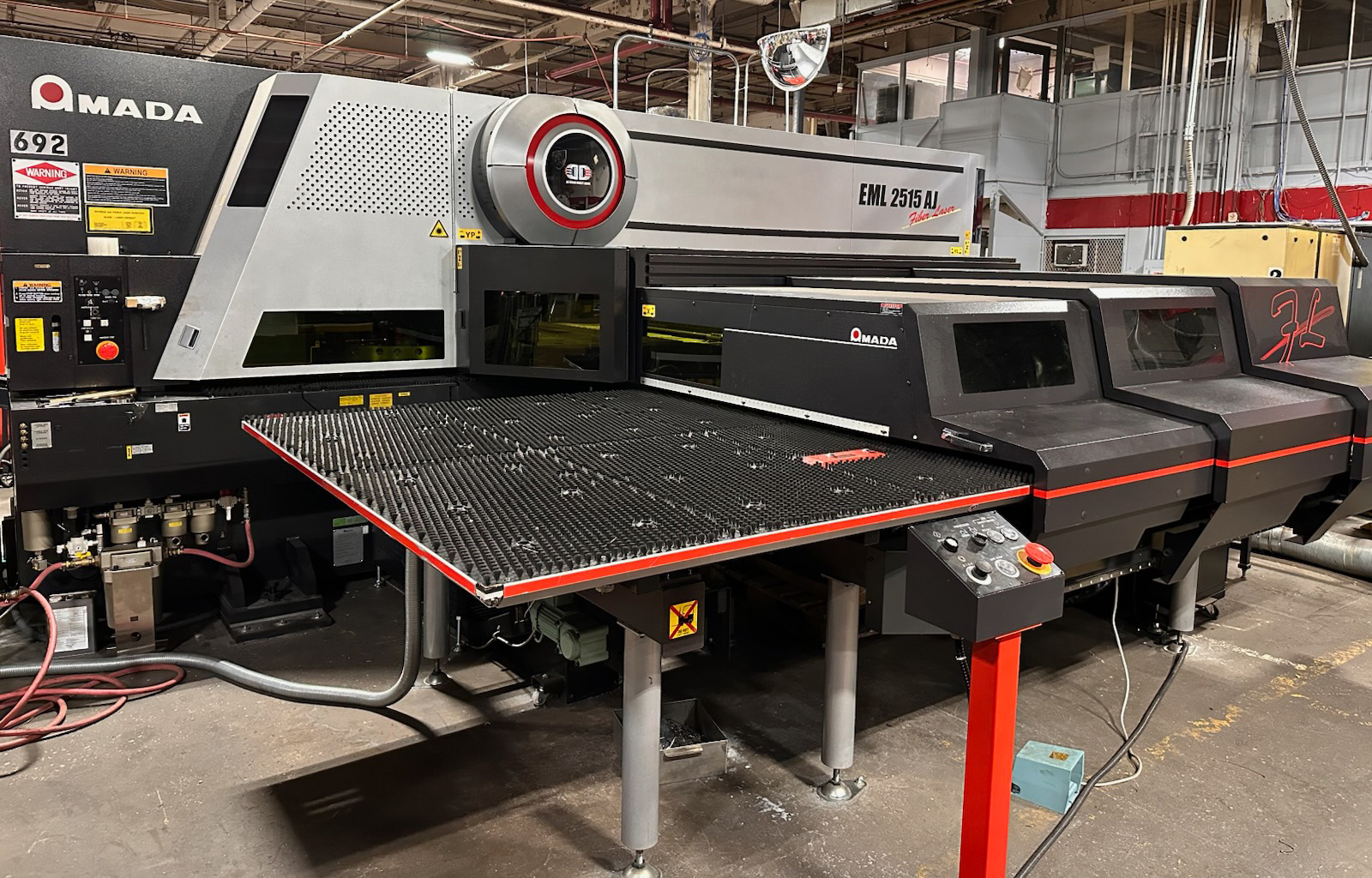
Laser cutting uses a high-intensity beam to slice through metals with extreme precision and minimal heat distortion. Advanced fiber lasers and CO₂ systems achieve edge tolerances of ±0.005 inches, enabling intricate patterns, fine holes, and detailed part geometries. Modern CNC-controlled laser systems — including Amada fiber lasers — can cut mild steel, stainless, and aluminum sheets at speeds exceeding 1,000 inches per minute while maintaining consistent edge quality.
Because laser cutting requires no hard dies, it is ideal for prototyping and short-run production, where flexibility outweighs tooling investment. Engineers can move directly from CAD design to a finished part within hours.
CNC Forming and Bending
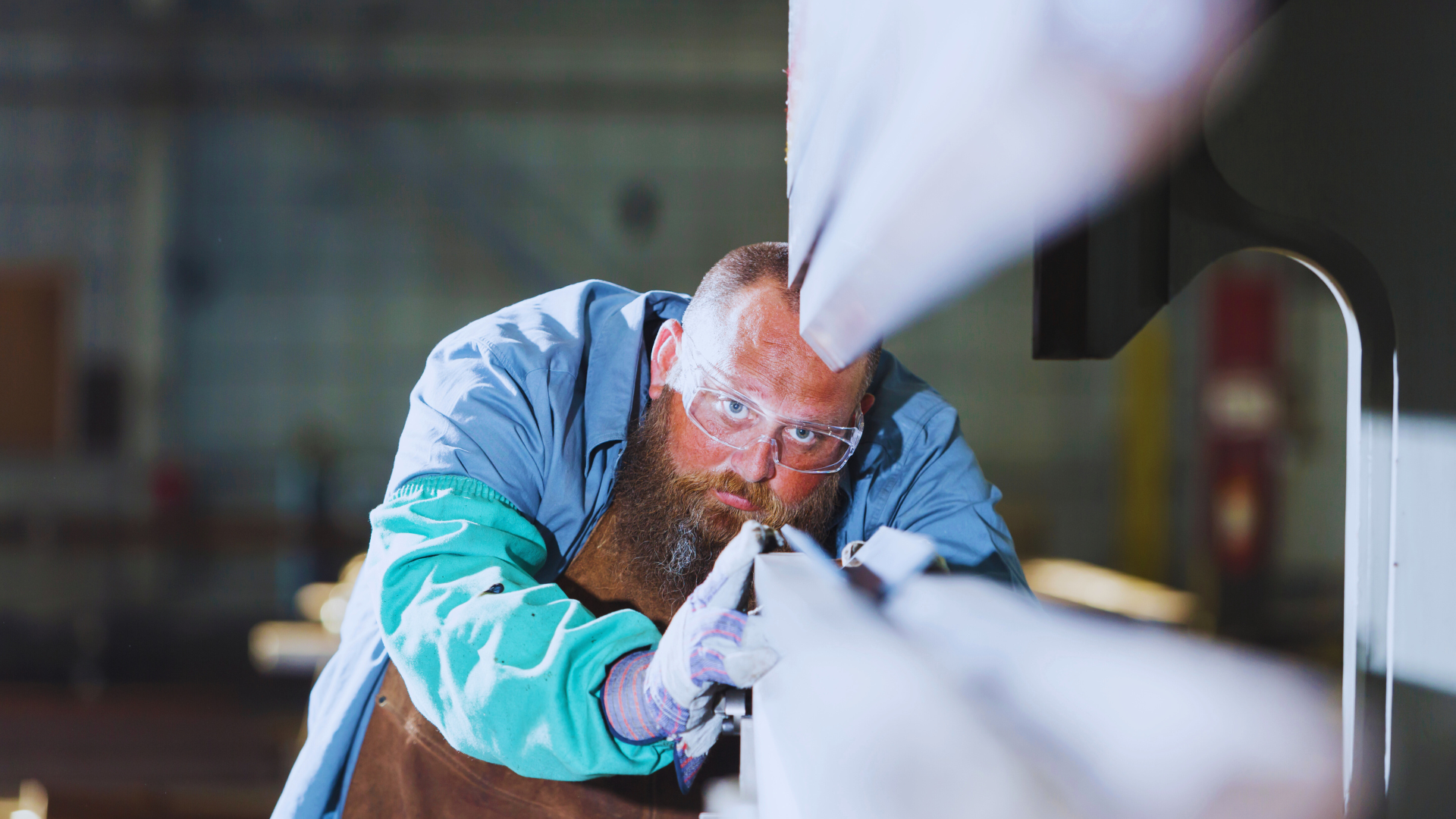
Once metal is cut, it’s shaped through press brakes or robotic forming systems. DureX uses Amada press brakes and robotic bending cells capable of up to 250 tons of pressure, producing complex geometries and repeatable bends across large batches — reducing manual variation and scrap.
Stamping
Stamping uses hard tooling and dies to form parts at very high speed and consistency. It becomes cost-effective at larger production volumes — typically above several thousand units — where the higher upfront tooling investment is offset by dramatically lower per-piece cost.
Welding (MIG, TIG & Robotic)
Welding fuses metal parts permanently, creating high-strength assemblies. MIG welding delivers high deposition rates for thicker materials; TIG provides fine control and clean seams for precision applications like medical devices or enclosures. Robotic welding stations enhance consistency, speed, and repeatability — key benefits when identical welds must be made quickly without variation.
All welding at DureX is performed by AWS-certified welders, ensuring compliance with industry and customer specifications.
Finishing and Coating
Once a part is formed, surface finishing protects it from corrosion and enhances appearance. Powder coating provides a durable, uniform finish resistant to chips and scratches. Silk screening allows part numbers or branding to be applied directly to the surface. Anodizing is used for aluminum components requiring enhanced surface hardness and corrosion resistance.
The DureX Advantage: Scale from Fabrication to Stamping
When a fabricated part costs $10 per piece, stamping can lower it to $6 — but only if production volume justifies the tooling investment. At 10,000–20,000 pieces, tooling often pays for itself within months. DureX manages this transition seamlessly: you stay with the same trusted supplier from prototype through mass production, eliminating costly supplier changes and production delays.
Benefits of Sheet Metal Fabrication
Scalability and Production Flexibility
Modern fabrication systems scale from one-off prototypes to high-volume production runs without disrupting workflow. Because methods like laser cutting and CNC bending rely on digital controls instead of fixed dies, engineers can modify designs quickly. As production grows, fabricators can transition from soft tooling to hard tooling or progressive dies to lower per-part costs — an approach supported by DureX’s multi-capability facility.
Precision and Consistency
CNC-driven fabrication systems maintain dimensional accuracy through automated feedback loops, minimizing human error and ensuring each part matches the digital blueprint. With laser cutting and robotic forming, tolerance levels of ±0.005 inches are standard. DureX’s Union, NJ facility backs this with ISO 9001:2015-certified processes and in-house inspection protocols at every production stage.
Reliability and Durability
Fabricated sheet metal components are designed to endure mechanical stress, temperature fluctuations, and environmental exposure. Through controlled processes such as TIG welding, powder coating, and anodizing, fabricators produce parts that perform reliably in demanding conditions — from HVAC systems in Edison to aerospace assemblies in Paterson. Components made from high-grade stainless steel, aluminum, or galvanized steel resist corrosion and maintain structural integrity even after years of use.
Industries That Depend on Sheet Metal Fabrication in NJ
Aerospace and Defense
Every aerospace component — an avionics housing, air duct, or bracket — must meet strict regulatory and dimensional standards. DureX fabricates to aerospace-grade specifications using CNC-controlled laser cutting, tight-tolerance forming, and TIG welding. Parts often require traceable materials and post-process inspections to ensure compliance with FAA and military standards.
Medical and Laboratory Equipment
The medical and pharmaceutical industries demand precision manufacturing under stringent cleanliness and compliance standards. DureX produces sterile, sealed enclosures for imaging systems, testing machines, and hospital devices using stainless steel and aluminum — materials that create smooth, non-porous surfaces easy to sanitize and resistant to disinfectant corrosion. Finished enclosures meet both FDA and ISO standards.
Construction and Infrastructure
New Jersey’s dense urban construction market — Newark, Jersey City, and beyond — depends on local fabricators who can provide quick turnarounds for project-specific metalwork: stair treads, architectural panels, custom ductwork, and weatherproof electrical enclosures. DureX’s NJ location and same-day delivery capability keep construction projects on schedule.
Electronics and Power Systems
For the electronics industry, precision fabrication ensures that enclosures, chassis, and heat-management components protect delicate circuitry. Controlled forming, powder coating, and silk screening provide functional strength, electromagnetic shielding, corrosion resistance, and finished branding — all under one roof.
Automotive and Transportation
From lightweight brackets and mounts to heavy-duty housings, sheet metal fabrication supports the automotive and transportation industries by improving vehicle efficiency and reliability. DureX helped one OEM reduce part costs by 35% by transitioning from fabricated assemblies to hard-tooled stamping once production volumes increased — a seamless supplier transition that saved months of delay.
Cost and Timeline Factors
Material Type and Thickness
The choice of metal is often the single biggest cost driver. Stainless steel and aluminum offer corrosion resistance but require more energy to cut and form than mild steel. DureX maintains on-site inventories of common sheet materials — including galvanized, cold-rolled, 304/316 stainless, and 6061 aluminum — to reduce sourcing delays and keep pricing stable for recurring customers.
Part Complexity and Design Requirements
Complex parts with multiple bends, cutouts, or welds demand longer machine time and greater operator oversight. DureX engineers work directly with OEM design teams to simplify geometries, combine features, or adjust tolerances — often reducing total fabrication cost significantly before production begins.
Tooling Strategy: Soft to Hard to Hybrid
In early production, soft tooling (laser-cutting programs, simple forming tools) keeps startup costs low. When demand increases, transitioning to hard tooling or progressive dies can cut the cost per part dramatically. Transitioning from soft to hard tooling has delivered ROI in as little as four months, reducing per-piece prices from $22 to $15 for high-volume runs. DureX’s one-stop model makes these transitions seamless.
Production Volume and Scheduling
The first units are always the most expensive. Programming machines, setting up jigs, and validating prototypes all involve fixed labor. Once production stabilizes, unit cost drops as throughput increases. While rapid prototyping may take days, production orders can range from one to six weeks — and NJ-based fabrication with DureX reduces this uncertainty through localized supply chains and real-time engineer-to-production communication.
By uniting cutting-edge automation with over 75 years of experience, DureX Inc. exemplifies how modern sheet metal fabrication continues to evolve, smarter, faster, and more reliable than ever before.
Why NJ-Based Fabrication Partners Offer Reliability and Speed
Selecting the right fabrication partner is as critical as the engineering design itself. The difference between success and costly delays often comes down to communication, control, and proximity.
Local Expertise, Global Standards
New Jersey’s manufacturing ecosystem is built on skilled tradespeople, advanced equipment, and a strong transportation network. DureX combines decades of technical experience with state-of-the-art automation to deliver products that meet or exceed international quality standards — while maintaining hands-on accountability throughout production. When engineering changes arise, local fabrication teams can respond immediately, saving time and keeping development cycles at full speed.
Integrated Manufacturing for Complete Control
A facility that handles every stage — laser cutting, CNC machining, welding, powder coating, and assembly — maintains full control over timelines and consistency. DureX’s integrated approach minimizes variability and prevents communication breakdowns between vendors. Every part undergoes continuous inspection at each step, reducing rework and enabling faster delivery throughout NJ and the Northeast corridor.
A Legacy of Precision and Performance
Since 1946, DureX has supported New Jersey’s industrial growth by combining traditional craftsmanship with modern manufacturing technology. Operating from a 120,000-square-foot facility in Union, NJ, the company continues to uphold its reputation for precision, speed, and reliability — whether producing five prototypes or fifty thousand parts.
Frequently Asked Questions
What industries use sheet metal fabrication?
Sheet metal fabrication is used across nearly every industrial sector — aerospace, medical, HVAC, construction, electronics, automotive, and telecommunications. In New Jersey, DureX supports OEMs across all of these markets from its 120,000-square-foot Union, NJ facility.
How long does sheet metal fabrication take?
Simple prototypes can often be completed within a few days; high-volume or multi-step assemblies may take several weeks. Partnering with a local NJ facility eliminates transit delays and communication barriers. Because DureX manages cutting, bending, welding, and coating in-house, lead times are significantly shorter compared to multi-vendor chains.
What are the common methods of sheet metal fabrication?
The core processes include laser cutting, CNC bending, stamping, MIG/TIG welding, robotic welding, and finishing (powder coating, anodizing, silk screening). Modern fabrication at DureX is highly automated, enabling precise and repeatable results throughout production runs.
How much does sheet metal fabrication cost?
Pricing depends on material type, thickness, design complexity, and order quantity. Thin-gauge aluminum parts with minimal forming cost less than thick stainless steel enclosures requiring multiple bends or welds. Tooling selection also plays a major role: switching from soft to hard tooling can reduce unit prices by up to 35% when volumes justify the investment.
Why choose a New Jersey-based fabricator?
Local fabrication provides speed, accountability, and consistent communication — key factors when deadlines are tight or product revisions are frequent. Working with DureX means projects move from design to production faster, with engineers and fabricators collaborating directly. NJ’s strong transportation network enables same-day delivery to many regional manufacturers across Union, Essex, Bergen, Hudson, and Middlesex counties.
Conclusion
Sheet metal fabrication is far more than a mechanical process — it’s the intersection of design, technology, and trust. It transforms raw materials into the structures that power industries and protect innovations. For OEMs across the Northeast, partnering with a New Jersey-based fabricator like DureX offers more than proximity: it delivers the control, agility, and quality that global competitiveness demands.
By uniting cutting-edge automation with over 75 years of experience, DureX Inc. exemplifies how modern sheet metal fabrication continues to evolve — smarter, faster, and more reliable than ever before.