

Sourcing metal stamping in New Jersey usually comes down to three questions: can the shop actually run the part, what will it cost, and how long will it take to get there. . Those answers depend less on marketing copy and more on tooling ownership, press capacity, material handling, and how many operations a supplier can complete without shipping the part somewhere else.
DureX runs metal stamping out of a single facility in Union, NJ, building and maintaining its own dies in-house rather than outsourcing tool and die work. That matters for buyers because tooling turnaround and tooling changes are usually the biggest swing factor in both cost and lead time — if the shop doesn’t own that step, you’re waiting on someone else’s schedule.
This page walks through what metal stamping services in New Jersey typically include, what capabilities to look for in a New Jersey provider, what drives pricing, and what actually affects how fast a job moves from quote to delivery.
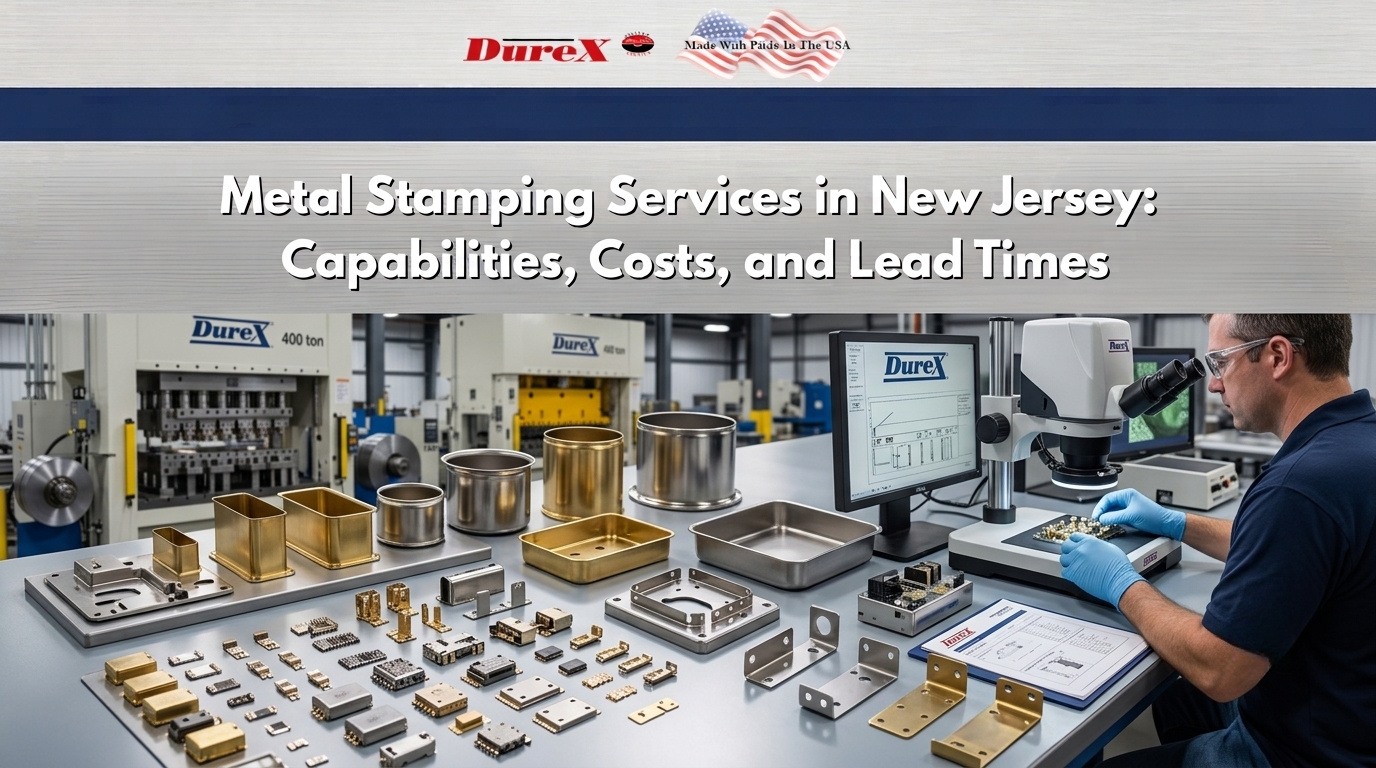
What Metal Stamping Services in New Jersey Include
Metal stamping covers a set of press-based operations that cut, shape, or form sheet metal into a finished part, usually using a die mounted in a mechanical or hydraulic press. The specific operations a job needs depend on part geometry, not on a single catch-all process.
Common operations include:
- Blanking — cutting a flat shape from sheet stock as the starting point for further forming
- Piercing — punching holes or cutouts into the blank
- Forming — bending or shaping the blank into a three-dimensional profile
- Trimming — removing excess material after forming
- Progressive die stamping — running the part through a sequence of stations in one die set, so blanking, piercing, and forming happen in a continuous strip feed rather than as separate setups
- Deep draw stamping — pulling flat sheet metal into a deep, hollow shape (like a can or housing) using a punch and die, for parts where depth exceeds what standard forming can produce without tearing or thinning the material
Many of these parts also need work that isn’t stamping in the strict sense but has to happen before the part is usable:
- Wire forming — shaping wire stock into brackets, clips, or springs that get integrated with a stamped assembly
- Shell trimming — a secondary trim pass on drawn or shelled parts to bring them to final dimension
- Double action pressing — using a press with two independent slide motions (typically a blank holder plus a draw punch) to control material flow during deep draws, reducing wrinkling or tearing on more complex shapes
- Tapping, welding, and assembly — turning a stamped component into a finished, installable part rather than a loose piece of formed metal
A supplier that runs stamping, tooling, and these secondary operations under one roof avoids the handoff delays that come from shipping a part to a second or third vendor between steps.
Typical Capabilities of New Jersey Providers
Capabilities vary more between individual shops than most buyers expect — metal stamping services in New Jersey can range from a two-press job shop to a facility running dozens of presses across a range of tonnages. What matters for sourcing is matching the part to a shop’s actual range, not assuming any stamping supplier can run any job.
Things worth checking before you send a quote request:
- Press range and count. How many presses does the shop run, and what tonnage range do they cover? A shop with only a handful of presses in a narrow tonnage band will bottleneck on scheduling faster than one with a wide range to draw from. DureX runs more than 50 presses from 5 to 400 tons, which covers light-gauge precision work and heavier forming without needing a second vendor.
- Material thickness range. Confirm the shop can run your gauge, not just your material type. Thin, precision-critical stock and heavier-gauge structural stock often need different press setups and die designs. Quality system and inspection. Look for a documented quality system (ISO 9001:2015 is the common baseline in this industry) along with first-article inspection and in-process dimensional checks, not just a claim of “quality control.
- In-house tooling. Ask directly whether dies are designed, built, and maintained on-site, or outsourced. Quality system and inspection. Look for a documented quality system (ISO 9001:2015 is the common baseline in this industry) along with first-article inspection and in-process dimensional checks, not just a claim of “quality control.” This is the single biggest factor in how fast a shop can respond to a die issue, a design change, or a tooling repair mid-run — a shop that owns the tool room controls its own schedule; one that doesn’t is waiting on someone else’s.
- Quality system and inspection. Look for a documented quality system (ISO 9001:2015 is the common baseline in this industry) along with first-article inspection and in-process dimensional checks, not just a claim of “quality control.”
- Engineering support before the job starts. Design-for-manufacturability (DFM) review and forming simulation catch problems — like springback or thinning at draw radii — before steel is cut for tooling, which is a lot cheaper than catching them after.
- Facility scale relative to your volume. A 120,000-sq.-ft. operation and a 10,000-sq.-ft. job shop can both call themselves a stamping supplier, but they’re suited to different order sizes and part complexity.
None of these are pass/fail on their own — a small shop with a narrow press range can still be the right fit for a simple, low-volume part. The point is to match the capability profile to the part, not to assume scale or equipment count settles the question by itself.
Materials and Part Types
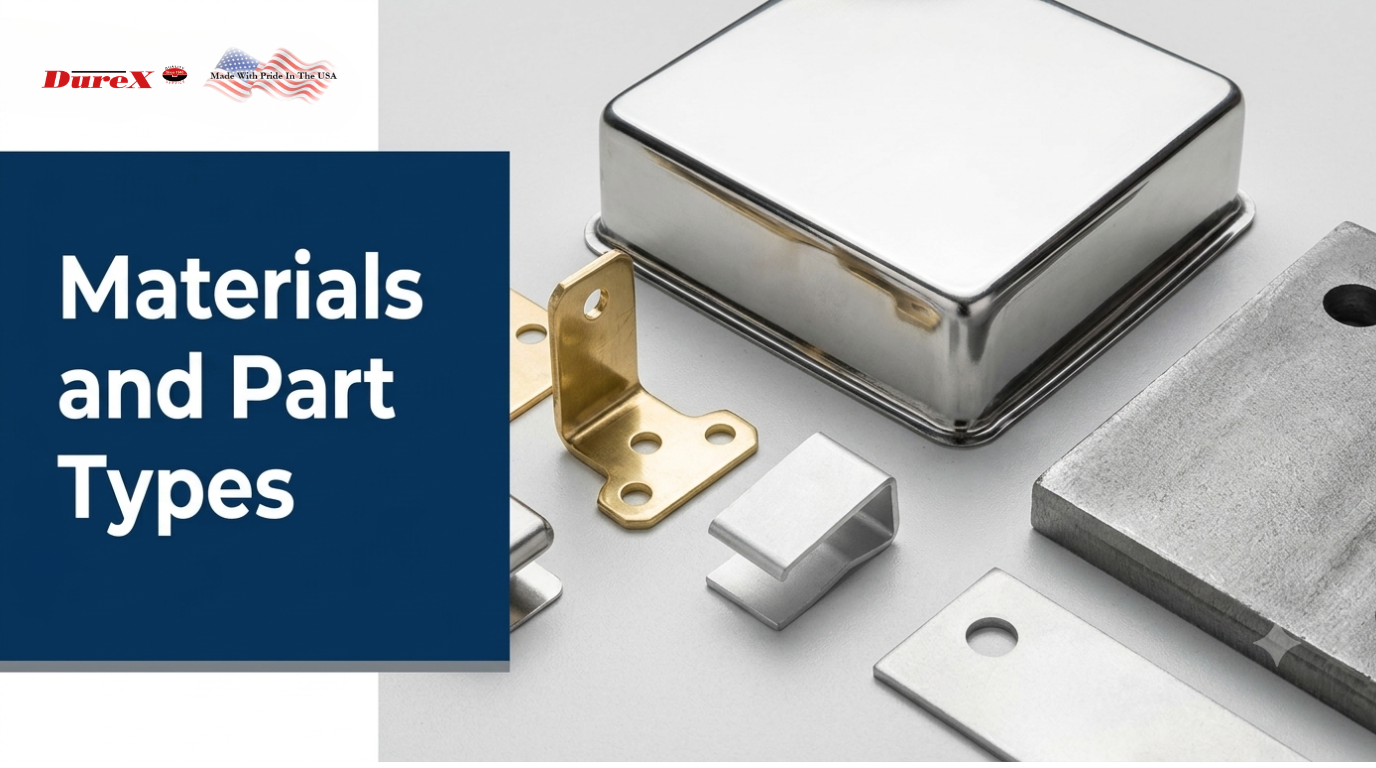
The right stamping process for a part depends as much on material behavior as on shape. Different alloys and grades respond differently under a die — some form cleanly at tight radii, others crack or spring back unless the process is adjusted for them.
Materials commonly run through stamping include:
- Cold-rolled steel — a common baseline for structural and general-purpose stamped parts where cost and formability matter more than corrosion resistance
- HSLA (high-strength, low-alloy) steel — used where the part needs to hold strength at a thinner gauge, common in structural brackets and automotive components
- 304 stainless steel — chosen for corrosion resistance and appearance, but it work-hardens faster than mild steel, which affects die design and press force
- 6061 aluminum — 6061 aluminum — lighter weight, good for parts where weight matters more than raw strength, with its own springback behavior that has to be accounted for in tooling
- Copper and brass — typically used for electrical, conductive, or decorative parts where the material’s conductivity or finish matters more than mechanical strength
DureX runs material thicknesses from .005″ up to .312″, which spans light-gauge precision electronic components on one end and heavier structural or enclosure-grade parts on the other.
Part type matters too, independent of material:
- Simple flat or lightly formed parts (brackets, mounting plates) are generally the least demanding on tooling and the fastest to quote
- Intricate or miniature parts need tighter die tolerances and often benefit from progressive die stamping to hold consistency across a production run
- Deep-drawn or shelled parts (housings, cans, enclosures) need draw-specific tooling and process control to avoid tearing or wrinkling
- Surface-critical parts — anything with a visible or cosmetic finish requirement — need handling and die maintenance considerations that a purely structural part doesn’t
When you’re evaluating a supplier, it’s worth naming both the material and the part type up front, since a shop that’s strong with mild steel brackets isn’t automatically the right fit for a deep-drawn stainless enclosure.
What Drives Cost
Pricing for metal stamping services in New Jersey isn’t a flat rate — it’s built from a handful of variables that move independently of each other. Understanding which ones apply to your part makes it easier to read a quote and to know what you’re actually negotiating.
Tooling
If the part needs a new die, tooling is usually the largest line item on a first order — and the only one that doesn’t recur on repeat runs once the die is built and paid for. Because DureX designs, builds, and maintains dies in-house rather than outsourcing that step, tooling changes and repairs during a run don’t carry a second vendor’s markup or wait time.
Part geometry and tolerances
A flat bracket with generous tolerances is a simpler die and a faster press cycle than a part with tight-tolerance features, multiple bends, or a deep draw. Tighter tolerances generally mean more die stations, more in-process inspection, and slower press speeds to hold consistency.
Material type and thickness
Different alloys respond differently under a die — some, like 304 stainless, work-harden faster and require more press force and die maintenance than mild steel. Thickness matters independently of material: running near the thin or thick end of a press’s working range (DureX covers .005″ to .312″) can call for a different setup than a mid-range gauge.
Order quantity and run length
Tooling cost gets spread across the run, so low-volume orders carry more tooling cost per part than high-volume ones. This is also where progressive die stamping earns its cost back — it’s more expensive to tool up front, but cheaper per part at volume because blanking, piercing, and forming happen in one continuous strip feed instead of separate setups.
Secondary operations
Anything beyond the stamped part itself — tapping, welding, wire forming, assembly, finishing — adds cost, but doing it under the same roof as the stamping avoids the shipping and scheduling markup that comes from routing the part through a second or third vendor.
None of these variables work in isolation — a low-volume order in a difficult material with tight tolerances stacks several cost drivers at once, while a high-volume flat part in an easy-forming material can be inexpensive per piece even with a real tooling investment up front. Naming the material, thickness, tolerance, and volume up front is what gets you an accurate quote instead of a rough estimate.
What Affects Lead Times
Lead time for metal stamping services in New Jersey depends on whether it’s a first-time part or a repeat run. For new parts, tooling design and build is usually the longest step — DFM review catches problems like springback before steel is cut, and because DureX builds and maintains its own dies in-house, design changes or die issues during proveout are resolved on-site rather than routed back through a second vendor’s queue.
Material sourcing, part complexity, and secondary operations add time on top of that. Common gauges are typically on hand; specialty alloys or uncommon thicknesses can add a step before the press even runs. A flat bracket clears tooling faster than a deep-drawn or multi-station progressive die part, and anything needing welding, tapping, or assembly afterward extends the timeline further — less so when those steps happen under the same roof as the stamping.
Shop capacity at order time matters too. A wide press range gives more scheduling flexibility, which is one reason it’s worth asking a supplier how they handle capacity, not just what their average lead time is.
How to Choose a NJ Metal Stamping Partner
Fit matters more than scale. A shop’s press range needs to cover your part’s tonnage and size, and its material and tolerance experience should match what you’re running — a supplier strong with mild steel brackets isn’t automatically right for a tight-tolerance stainless part. In-house tooling and engineering support are worth confirming directly, since a shop that owns its tool room controls its own schedule instead of waiting on an outside vendor for repairs or design changes.
Secondary operations under one roof — welding, tapping, assembly, finishing — cut out the shipping and scheduling delays that come from routing a part through multiple vendors between steps. A documented quality system, first-article inspection, and in-process dimensional checks are the baseline for consistency across a run, not just a claim of quality control. And since needs change over time, it’s worth confirming a supplier can scale a part from prototype through full production without a handoff to a different shop mid-program.
When Short-Run Stamping Makes Sense
Short-run metal stamping services in New Jersey fit situations where full production tooling isn’t justified yet — early-stage products still being validated, bridge production while permanent tooling is built, design iterations that might change the part again, or specialized parts with limited volume.
The advantage of working with a supplier that also runs production-scale stamping is that the same part can move from short-run to volume without changing vendors. Because DureX designs and builds its own tooling in-house, a die built for an early run can often be revised or scaled rather than replaced outright as the part moves toward production — which matters more for cost and lead time than the short-run process itself.
Requesting a Quote
An accurate quote for metal stamping services in New Jersey — and a lead time estimate that actually holds — depends on how much information goes in with the request.
- CAD files or drawings — 2D or 3D, with critical dimensions and features called out
- Material specification — type, grade, and thickness
- Volume — annual volume and expected release quantity per order, since this affects both tooling amortization and press scheduling
- Tolerance requirements — especially on any tight or surface-critical features
- Secondary operations — welding, tapping, assembly, or anything the part needs beyond the stamped shape
- Finish or coating requirements
- Target delivery date
Leaving any of these out doesn’t stop a supplier from quoting — it just means the number comes back as a rough estimate instead of a firm price, and the estimate is more likely to shift once the part is actually reviewed.
FAQ
How much does metal stamping cost?
NJ stamping shops commonly serve electronics, automotive, medical device, industrial equipment, and building products manufacturers — industries that need precision formed metal parts at repeatable tolerances.
How much does metal stamping cost?
Cost depends on tooling, material, tolerances, volume, and secondary operations — there’s no flat rate. Low-volume orders carry more tooling cost per part; higher volumes spread that cost across more units.
What’s the difference between short-run and production stamping?
Short-run stamping supports early-stage or lower-volume parts without committing to full production tooling. Production stamping uses hard tooling built for high-volume, repeatable runs, often with progressive dies.
Can NJ stampers handle secondary operations in-house?
It varies by shop. Suppliers that run welding, tapping, assembly, and finishing under the same roof as stamping avoid the delays that come from shipping a part to a separate vendor between steps.
What information do I need to request a quote?
CAD files or drawings, material specification, volume, tolerance requirements, secondary operations, finish needs, and a target delivery date.