
A lot of custom metal parts never make it to full production — not because the design was bad, but because nobody stress-tested it before committing to hard tooling. Teams move from a CAD drawing straight into production dies, then discover downstream that the part doesn’t form the way it was modeled, tolerances drift under real press conditions, or a secondary operation nobody planned for adds cost and lead time.
Custom metal stamping in NJ works best when it’s treated as a staged process, not a single transaction. The prototype phase exists to catch these problems while they’re still cheap to fix — before steel is cut for production tooling. Durex works with engineering and procurement teams across New Jersey to move parts through that process deliberately: validating the design, proving out the tooling approach, and scaling into production only once the part is ready to be made consistently, run after run.
This article walks through what that path actually looks like — from first sample to full production — and what to look for in a stamping partner along the way. Durex’s expert metal stamping services in NJ are built around exactly this staged approach, combining in-house tooling with press capacity to support parts at every phase.
What Custom Metal Stamping Is
Metal stamping is a manufacturing process that forms flat sheet or coil metal into a specific shape using a die and a press. Custom metal stamping in NJ follows this same fundamental process, though the specific operations used depend on the part’s geometry and how it needs to perform. Instead of removing material like machining does, stamping reshapes it — cutting, bending, and forming the metal in one or more press strokes until it matches the finished part geometry.
A single stamped part can involve several operations, depending on its complexity:
- Blanking – cutting a flat shape from sheet or coil stock
- Piercing – punching holes or openings into the part
- Bending – forming angles or curves along a controlled bend line
- Forming – shaping the metal into a three-dimensional profile
- Coining – applying high pressure to create sharp, precise details
- Deep drawing – stretching metal into a deeper, cup-like or enclosed shape
For low-complexity parts, one or two of these operations might be enough. For deeper, hollow, or cup-shaped components, deep draw stamping is often the more cost-effective process at volume compared to alternatives like hydroforming. For more complex components, a progressive die performs multiple operations in sequence as the metal strip advances through the press — cutting, forming, and finishing the part in a single continuous run. This is what makes high-volume production efficient: once the die is built and proven, it can repeat the same sequence thousands or millions of times with tight, consistent tolerances. A closer look at how progressive stamping dies advance metal strip through multiple stations in a single press stroke explains why this method scales so efficiently.
The key point for buyers: the die is the expensive, time-consuming part of this process. Everything in the prototype phase exists to make sure that die is designed right the first time.
Why Prototype Stamping Matters
Before a production die is built, a stamped part needs to prove itself. That’s what the prototype phase is for — not as a formality, but as a checkpoint that answers questions no CAD model can fully answer on its own.
A prototype or sample run shows how the part actually behaves once it’s made from real material on real tooling. That includes things like:
- Fit and function — does the part mate correctly with adjacent components, and does it perform as intended in the assembly?
- Material response — how does the chosen metal behave under forming, bending, or drawing? Does it crack, spring back, or thin out more than expected?
- Tolerance feasibility — can the specified tolerances actually be held in production, or do they need to be adjusted before tooling is finalized?
- Manufacturability — are there features in the design that will cause problems at volume, like sharp internal corners, tight bend radii, or hole placement too close to an edge? This kind of upfront evaluation is a core principle of design for manufacturability, which focuses on reducing production cost and risk by addressing buildability early in the design phase rather than after tooling is cut.
Catching these issues in a prototype run is inexpensive relative to catching them after a production die is cut. A design change at the sample stage might mean adjusting a drawing. The same change discovered after tooling is built can mean reworking or scrapping a die — along with the schedule delay that comes with it.
This is why sample parts and pilot runs should be treated as decision tools, not just proof-of-concept pieces. They give engineering and procurement teams the data they need to commit to a tooling investment with confidence, instead of hoping the part scales the way it looked on screen.
The Prototype-to-Production Workflow
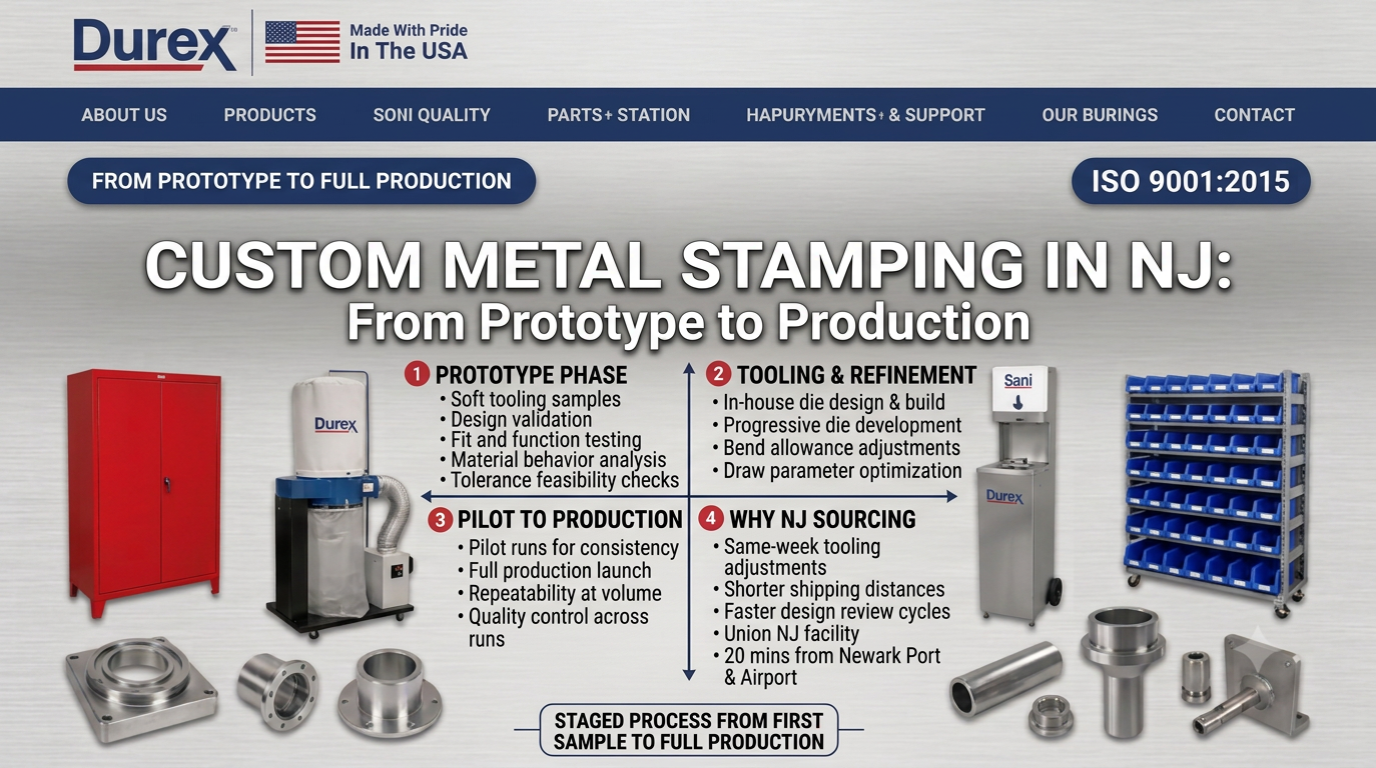
Moving a part from concept to full production isn’t a single leap — it’s a sequence of stages, each one reducing risk before the next begins. While every program has its own variables, a well-run custom metal stamping process in NJ generally follows six steps:
- Design review
The process starts with a review of the part drawing, CAD model, and functional requirements. This is where a stamping partner should flag potential manufacturability issues early — tight radii, awkward hole placement, or geometry that will be difficult to hold in tolerance once it’s in production. Reviewing the different types of stamping dies available — progressive, compound, or transfer — at this stage helps determine the right tooling strategy before development begins. - Material and tolerance planning
Next, the right material grade and thickness are selected based on how the part needs to perform, and tolerances are set based on what’s actually achievable in stamping — not just what looks clean on a drawing. This step often involves back-and-forth between the supplier and the design team to align expectations before anything is cut. - Prototype or sample run
A small batch of parts is produced, often using soft tooling or a simplified die, to confirm form, fit, and function. This is the checkpoint described in the previous section — the point where problems get caught while they’re still cheap to fix. - Tooling refinement
Based on what the prototype run reveals, the die design is adjusted. This might mean revising bend allowances, adjusting bend or draw parameters, or refining the tooling sequence in a progressive die. The goal is a design that will run reliably and repeatably at volume. - Pilot production
Before full-scale manufacturing begins, a pilot run tests the refined tooling at a larger — but still limited — quantity. This confirms that the process holds up consistently across a longer run, not just a handful of sample parts. - Full production launch
Once the pilot run confirms consistency, the part moves into full production. At this stage, the focus shifts to repeatability, throughput, and quality control across ongoing runs — not proving the design anymore, but maintaining it.
Each stage builds on the one before it. Skipping a step — especially prototype or pilot runs — is usually where scaling problems start.
Capabilities That Matter in a Stamping Partner
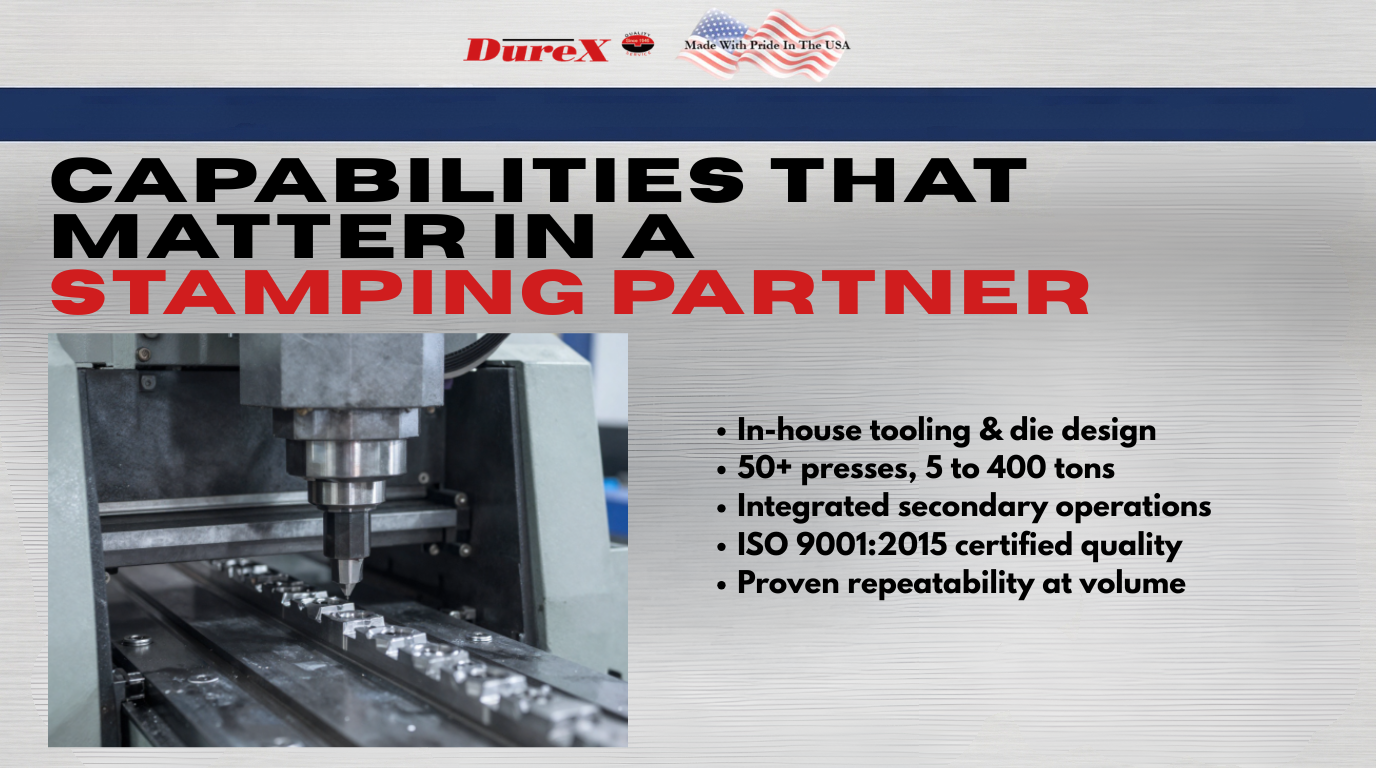
Not every stamping supplier is equipped to take a part all the way from prototype to volume production. Choosing a partner with the right capabilities upfront avoids a painful mid-program switch later. Here’s what actually matters:
In-house tooling and die design
A supplier that designs and builds dies in-house can move faster and communicate more directly during the prototype and refinement stages. When tooling changes are needed — and they usually are — in-house capability means those changes happen in days, not weeks of back-and-forth with a third-party tool shop.
Press capacity and range
Different parts call for different press tonnage, bed size, and stroke length. A supplier with a range of press capabilities can handle a part at prototype scale and continue running it at full production volume, without needing to hand it off to a different shop as quantities grow.
Secondary operations
Many stamped parts need more than the stamping process alone — welding, plating, heat treating, tapping, or assembly. A partner that can manage these secondary operations, either in-house or through a coordinated supply chain, reduces the number of vendors a buyer has to manage and keeps the part on a single, accountable timeline. Durex’s in-house finishing services, including powder coating and custom masking, along with CNC machining capabilities, are two examples of how secondary operations can stay under one roof.
Inspection and quality control
Consistent parts require consistent measurement. Look for suppliers with defined inspection protocols — first-article inspection, in-process checks, and documented quality systems — so that part 1 and part 100,000 meet the same specification. These practices typically align with ISO 9001 quality management system requirements, the internationally recognized framework for consistent, documented quality control.
Repeatability at volume
Ultimately, the question that matters most for production is whether the process holds up run after run. A supplier should be able to speak specifically to how they maintain tight tolerances and consistent output as volume scales, not just how they handle a one-off sample.
The strongest stamping partners support both ends of this spectrum — short-run development work when a part is still being proven, and larger production programs once it’s ready to scale. This is the standard buyers should hold any provider of custom metal stamping in NJ to, regardless of part size or industry.
Why NJ Sourcing Helps
For regional buyers, working with a New Jersey metal stamping company isn’t just about convenience — it changes how the prototype-to-production process actually runs. For companies sourcing custom metal stamping in NJ specifically, this proximity advantage tends to matter most during the stages where fast iteration makes the biggest difference.
Design reviews and tooling adjustments often require quick, detailed conversations, especially during the prototype and pilot stages. A supplier in the same time zone, or close enough for an in-person visit, can turn around questions and revisions faster than one managed entirely through email across time zones or long shipping lanes. When a die needs a same-week adjustment based on sample results, geographic proximity turns that into a short conversation instead of a multi-week delay.
Logistics is the other practical factor. Shorter shipping distances mean lower freight costs, fewer customs or import complications, and more predictable lead times — particularly useful during pilot production, when quantities and schedules are still being finalized and buyers need flexibility, not rigid overseas shipping schedules.
None of this means local sourcing is automatically the right choice for every program. But for New Jersey and Northeast-based manufacturers building or refining a part, working with a regional stamping partner removes a layer of friction from a process that already has enough variables to manage. Durex’s metal stamping capabilities reflect this regional advantage, with press capacity and tooling resources based in Union, NJ, supporting both prototype and production work locally.
How to Choose the Right Supplier
Selecting a stamping partner is easier when it’s treated as an evaluation, not just a quoting exercise. This is especially true when comparing providers of custom metal stamping in NJ, where capabilities can vary significantly from one shop to the next. The following checklist covers the areas that tend to separate a reliable long-term partner from a supplier that’s only equipped to handle a one-time order.
Design support
Does the supplier review drawings critically and flag manufacturability issues before tooling begins — or do they simply quote what’s sent to them? A partner who pushes back on a problematic feature early is saving you a production headache later.
Material expertise
Can they advise on material selection based on how the part needs to perform, not just what’s cheapest or fastest to source? Understanding how different grades and thicknesses behave under forming and drawing matters as much as the die design itself.
Tooling ownership
Who owns the die — the supplier or the buyer — and what does that mean for cost, lead time, and flexibility if a second source is ever needed? This should be clarified before a program starts, not after.
Turnaround time
How quickly can the supplier move from design review to prototype, and from prototype to pilot production? Turnaround matters most during the prototype and refinement stages, when speed directly affects how fast a design can be validated.
Quality systems
What inspection processes are in place, and how are they documented? Ask specifically about first-article inspection and in-process quality checks, not just a general assurance of “quality parts.”
Ability to scale
Can this supplier take the part from a handful of prototype units to full production volume without a vendor transition in between? A supplier who can only handle one end of that range introduces risk exactly when a program is gaining momentum.
The best partners don’t just take an order — they advise on cost savings, flag manufacturability risks, and help a program avoid decisions that look fine at low volume but become expensive at scale. For buyers weighing material and process tradeoffs, resources like Durex’s guide on ways to reduce sheet metal fabrication costs illustrate the kind of cost-saving advice a strong partner should offer proactively.
Talk to Durex About Your Stamping Project
If you’re working on a part that needs to move from concept to production, the earlier a stamping partner gets involved, the fewer surprises you’ll run into later. Durex works with engineering and procurement teams across New Jersey to review designs, validate prototypes, and build a clear path to full production. As a trusted provider of custom metal stamping in NJ, Durex supports programs at every stage — from a first design review to ongoing production runs.
Whether you’re just starting to evaluate a design or you’re ready to move into pilot production, here’s how to get started:
- Share your part drawings for a manufacturability review
- Request a prototype run to validate fit, form, and material behavior
- Discuss tooling strategy before committing to a production die
- Get a production quote once your design is ready to scale
No part is too early-stage to start the conversation. Contact Durex to talk through your project and find out what the path from prototype to production looks like for your part.
Frequently Asked Questions
What is the difference between prototype stamping and production stamping?
Prototype stamping uses sample parts — often made with soft or simplified tooling — to validate a design’s fit, function, and manufacturability before committing to a full production die. Production stamping uses hardened, refined tooling built to run consistently at volume, often through a progressive die that performs multiple operations in a single sequence.
How long does the prototype-to-production process take?
Timelines vary based on part complexity, but the process typically moves through design review, material and tolerance planning, a prototype run, tooling refinement, pilot production, and full production launch. Simple parts may move through these stages in a matter of weeks; more complex geometries or tighter tolerances can extend the timeline, particularly if tooling refinement is needed after the prototype run.
What should I send a stamping supplier for a quote?
At minimum, a supplier needs a part drawing or CAD model, material specification, expected volume, and any critical tolerances or finish requirements. The more context provided upfront — including intended application and assembly requirements — the more accurate the initial quote and design feedback will be.
What capabilities matter most in a metal stamping partner?
In-house tooling and die design, sufficient press capacity for the part’s size and volume, support for secondary operations, documented inspection and quality control processes, and a proven ability to maintain repeatability as production scales.
Why choose a New Jersey stamping company?
Buyers evaluating custom metal stamping in NJ specifically benefit from shorter feedback loops and fewer scheduling delays tied to distance or time zones. It also reduces shipping distance and lead-time variability, which is especially useful while quantities and schedules are still being finalized.