
DureX Inc. is a custom metal enclosure manufacturer New Jersey OEMs and engineers can count on, fabricating sheet metal housings, cabinets, and electrical enclosures at our Union facility. Our in-house capabilities include CNC laser cutting, turret punching, precision forming, MIG and TIG welding, powder coating, hardware installation, and assembly. DureX is ISO 9001:2015 certified and supports projects from prototypes through scalable production. We serve OEMs, engineers, and industrial buyers throughout New Jersey and the Tri-State region.
Whether you need a single prototype or a recurring production run, our team reviews your drawings and requirements to build custom metal enclosure fabrication around your equipment. Because cutting, forming, welding, and finishing happen under one roof, you work with one supplier instead of coordinating several. Explore Custom Metal Enclosure Fabrication Send a drawing, CAD file, sample, or project requirements for review.
Custom Metal Enclosure Manufacturer New Jersey: Why Local Fabrication Matters
Working with a New Jersey metal enclosure manufacturer puts your design, procurement, and fabrication teams within easy reach of each other. That proximity makes it simpler to review drawings, approve samples, and resolve questions before they affect your schedule. DureX fabricates custom metal enclosures from its Union, New Jersey facility, providing a single point of contact for cutting, forming, welding, finishing, and assembly. We also support manufacturers across New Jersey, New York, Pennsylvania, Connecticut, and the wider Tri-State area, as well as customers beyond the region.
Choosing a custom metal enclosure manufacturer New Jersey businesses can visit in person helps in several practical ways:
- Faster collaboration between design, procurement, and shop floor teams
- Easier facility visits, first-article reviews, and sample approvals
- Simpler logistics than working with distant or offshore suppliers
- Clearer communication around design changes, quality concerns, and production schedules
Our 120,000-square-foot facility keeps these operations together, so changes to a drawing or finish do not have to pass through multiple vendors. This helps your project stay coordinated from the first review through final delivery.
If your project also needs welded frames or supporting structures, our custom welded metal assemblies can be built alongside the enclosure. Keeping those pieces with one supplier reduces handoffs and makes fit-up easier to manage.
Custom Metal Enclosure Capabilities at DureX
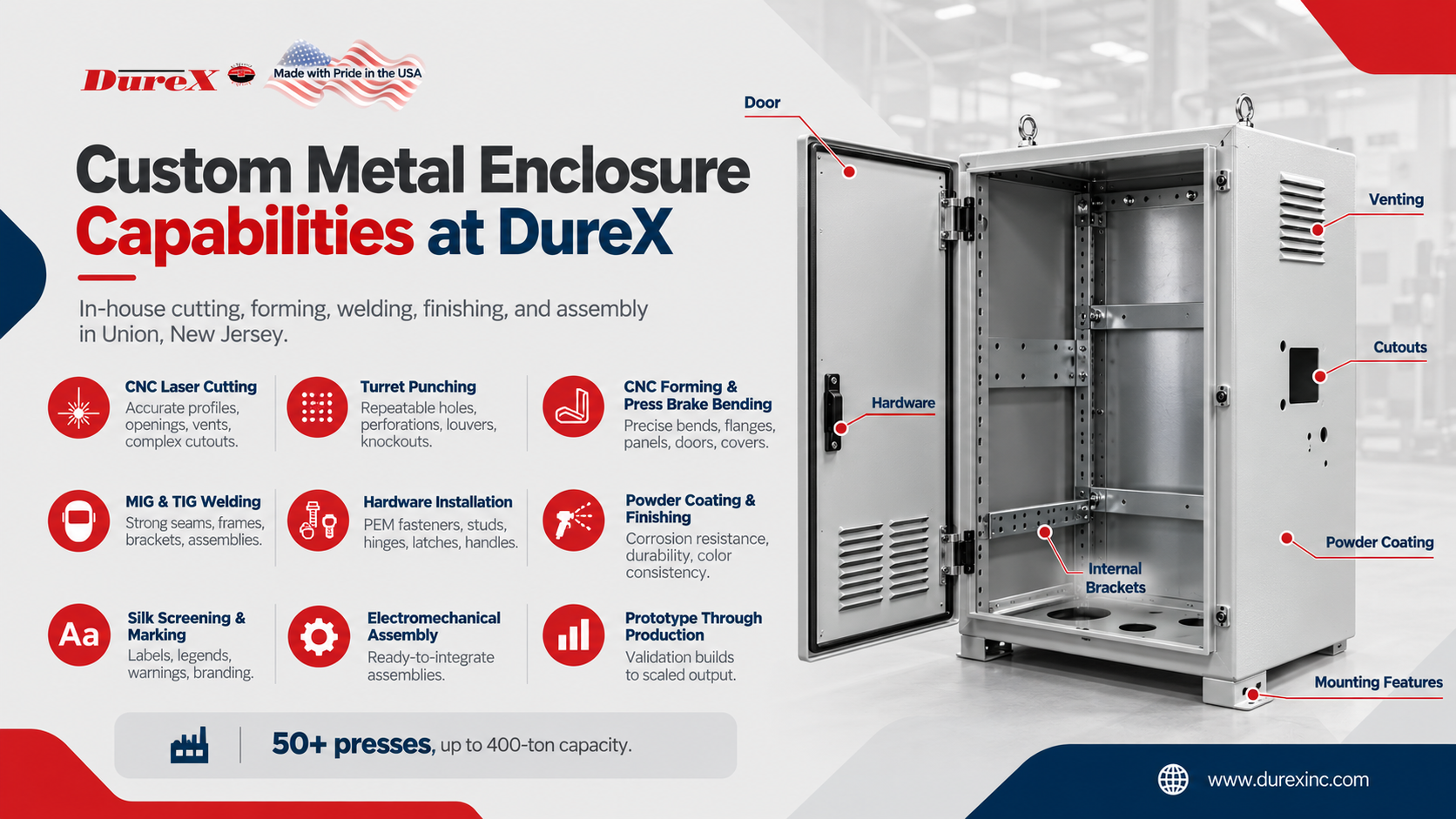
Our custom metal enclosure manufacturer New Jersey facility handles cutting, forming, welding, finishing, and assembly in-house in Union. Our floor includes CNC laser cutting, turret punching, and more than 50 presses with capacities up to 400 tons. Each process is matched to the enclosure’s material, geometry, and finish requirements. The table below shows how each capability supports an enclosure project.
| Capability | What it enables for enclosure projects |
| CNC laser cutting | Accurate exterior profiles, ports, openings, vents, and complex cutouts without dedicated tooling for every design |
| Turret punching | Repeatable holes, perforations, louvers, knockouts, and formed features |
| CNC forming and press brake bending | Precise bends, flanges, panels, doors, and covers for consistent fit-up and rigidity |
| MIG and TIG welding | Strong seams, frames, brackets, and assemblies, matched to the material and appearance requirements |
| Hardware installation | PEM fasteners, standoffs, studs, hinges, latches, and handles installed before delivery |
| Powder coating and finishing | Corrosion resistance, durability, and color consistency based on the operating environment |
| Silk screening and marking | Labels, warnings, control legends, and branding on the finished enclosure |
| Electromechanical assembly | Ready-to-integrate assemblies that reduce supplier handoffs |
| Prototype through production | Validation builds, pilot runs, repeat production, and scaled output |
Laser cutting and turret punching define the flat pattern of an enclosure, including its vents, cutouts, and mounting openings. Press brake forming then turns that pattern into panels, doors, and covers that fit together consistently from one part to the next.
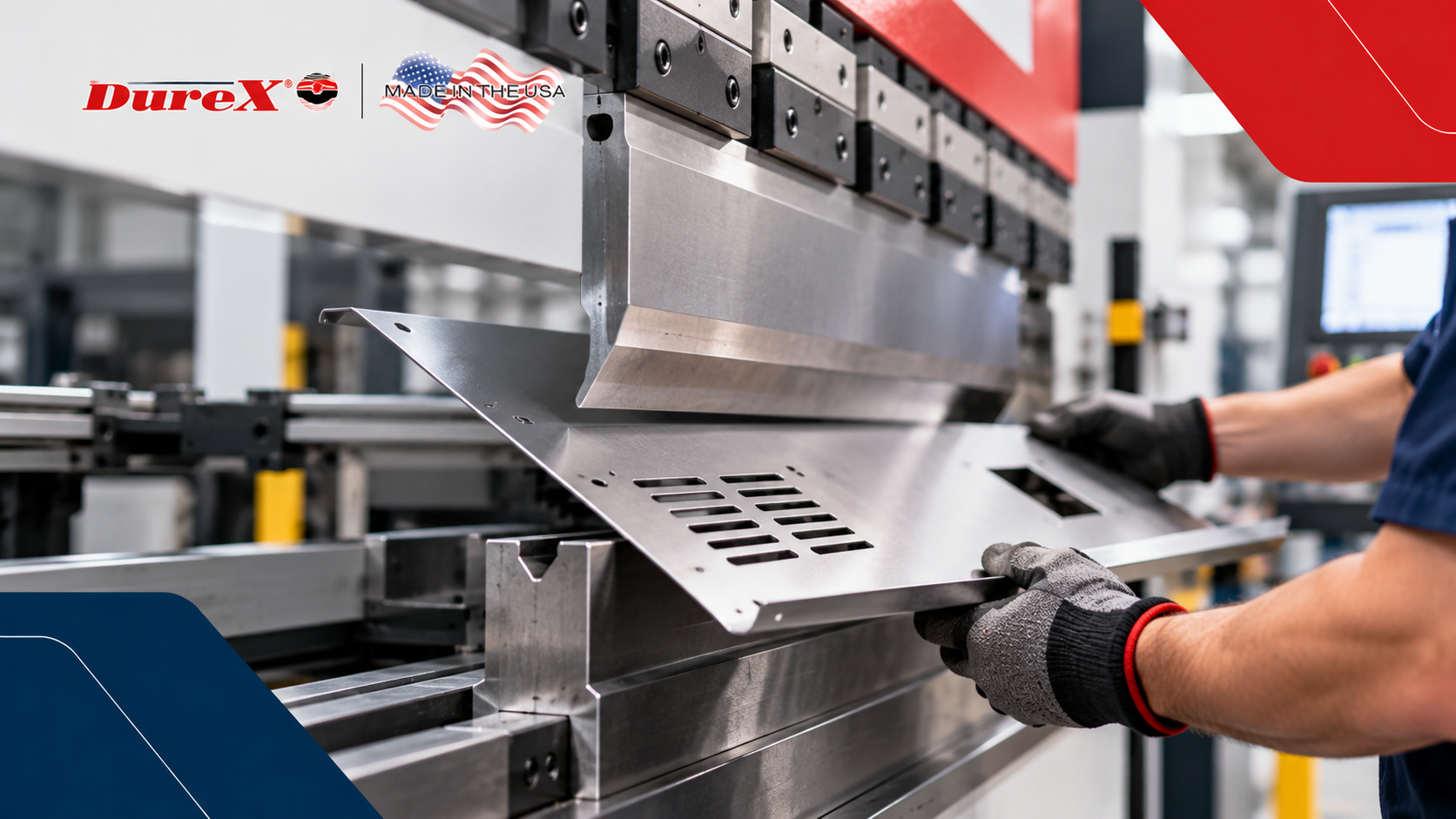
Welding joins those formed parts into frames and seams, and the process is chosen to suit the material and how the finished surface will look. Powder coating, hardware installation, and silk screening follow, so the enclosure arrives finished and ready for your components.
Our custom sheet metal fabrication services support projects from prototypes through scalable production runs. For parts that need machined features or integrated housings, our CNC machining services in New Jersey can work alongside the enclosure.
Enclosure Materials and Finishes
The right material and finish for a custom metal enclosure depends on where it will be used, what it will be exposed to, and how it needs to look. DureX works with stainless steel, aluminum, mild steel, and brass, with finishing options that include powder coating, anodizing, polishing, and chromate conversion. Each choice affects corrosion resistance, weight, strength, and cost. The table below compares the most common options for enclosure projects.
| Material / finish | Best suited for | Benefits | Important consideration |
| Cold-rolled or mild steel | General industrial cabinets, equipment housings, indoor enclosures | Cost-effective, strong, and widely formable | Usually needs a coating or finish for corrosion protection |
| Stainless steel | Washdown, corrosive, outdoor, medical, food-related, or demanding environments | Strong corrosion resistance and durable appearance | Higher material and fabrication cost than mild steel |
| Aluminum | Lightweight housings, electronics, portable equipment | Lower weight and good corrosion resistance | May need design adjustments for stiffness and joining |
| Galvanized steel | HVAC, utility, and industrial applications | Protective zinc coating and economical corrosion resistance | Cut edges and finish requirements should be evaluated |
| Powder coating | Many steel and aluminum enclosure projects | Durable, consistent, chip-resistant finish | Color, texture, chemical exposure, and environment all matter |
| Anodizing | Primarily aluminum enclosures and components | Improves corrosion resistance and appearance | Applies to aluminum only, so specify it early |
No single material or finish is right for every enclosure. Exposure, temperature, electrical requirements, appearance, and expected service life should guide the decision rather than cost alone.
Mild steel is often the practical choice for indoor industrial housings, while stainless steel is commonly selected where corrosion or washdown is a concern. Aluminum makes sense when weight reduction matters, such as in electronics or portable equipment.
A coating does not make an enclosure NEMA-rated on its own. Suitability depends on the full design, including seams, doors, gaskets, cutouts, and hardware, and any validation the application requires.
Our precision sheet metal fabrication services cover these materials and finishes, so you can discuss options with the team that will build the enclosure. Sending your operating environment along with your drawings helps us recommend a suitable combination early.
Types of Custom Enclosures We Fabricate
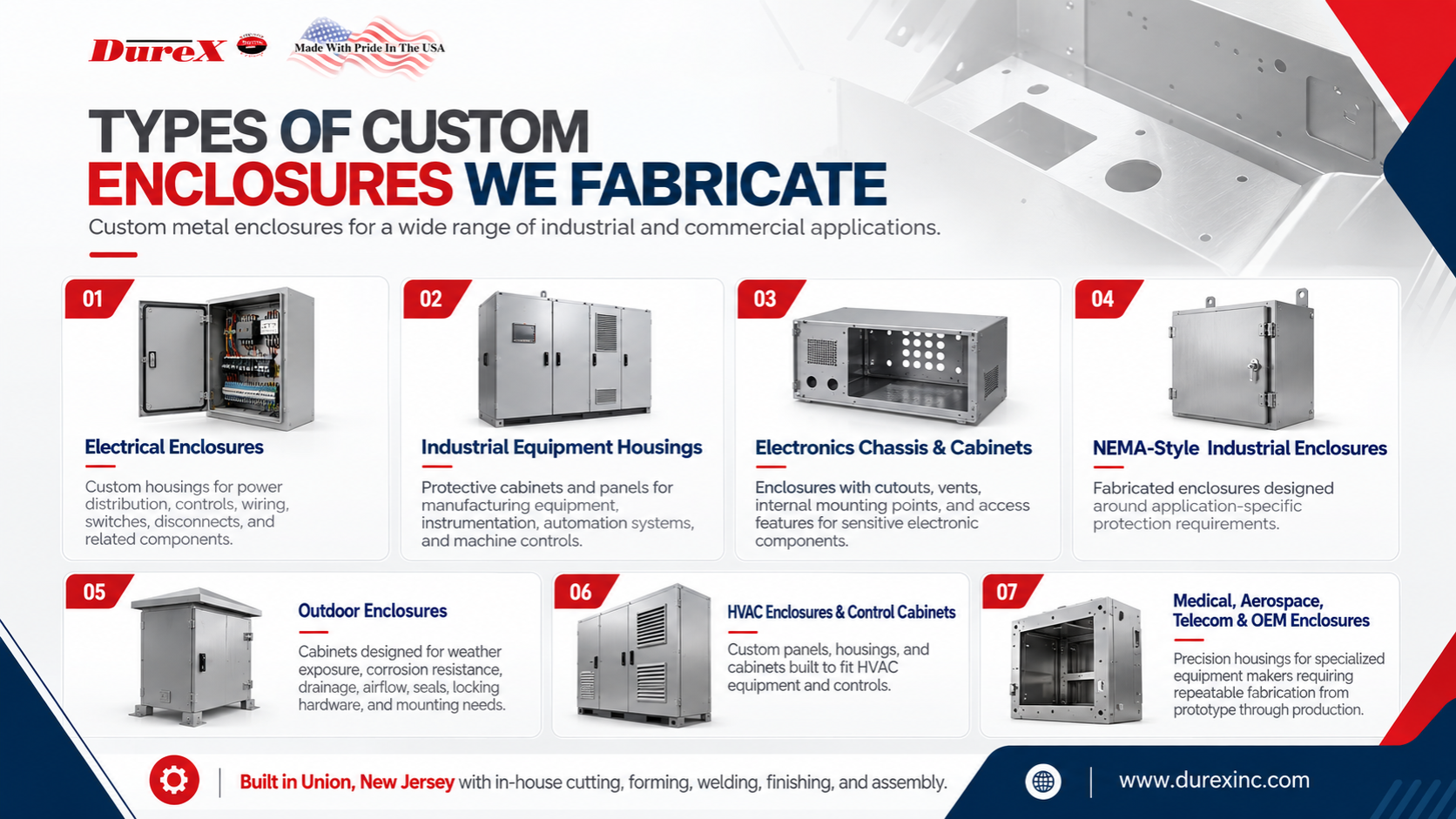
DureX fabricates custom metal enclosures for a range of applications, from electrical power and controls to electronics and industrial equipment. Each type has its own requirements for access, airflow, sealing, and finish. Starting from your application lets us choose the right material, features, and hardware for the job. The list below covers the enclosure types we build most often.
- Electrical enclosures: Custom housings for power distribution, controls, wiring, switches, disconnects, and other electrical components. Cutouts, mounting points, and grounding features are set to match your layout.
- Industrial equipment housings: Protective cabinets and panels for manufacturing equipment, instrumentation, automation systems, and machine controls. They are built to fit the machine and the plant environment.
- Electronics chassis and cabinets: Enclosures with cutouts, vents, internal mounting points, and access features for sensitive electronic components. Standoffs and brackets can be installed before delivery.
- NEMA-style industrial enclosures: Fabricated enclosures designed around application-specific protection requirements. The final design determines whether a particular rating can be supported.
- Outdoor enclosures: Cabinets planned around weather exposure, corrosion resistance, drainage, airflow, seals, locking hardware, and mounting needs. Material and finish are chosen for the site conditions.
- HVAC enclosures and control cabinets: Custom panels, housings, and cabinets for HVAC equipment and controls. They can be built to fit the unit and its wiring.
- Medical, aerospace, telecom, and OEM enclosures: Housings for equipment makers who need consistent, repeatable fabrication from prototype through production. Requirements for each market are reviewed at the start of the project.
Many of these projects share the same core steps of cutting, forming, welding, finishing, and assembly. What changes from one application to the next is the combination of material, sealing, and internal features.
If your project involves heating, ventilation, or air conditioning equipment, our custom HVAC enclosures and control cabinets can be built to your unit’s dimensions and wiring layout. Sending your equipment specifications with your drawings helps us plan the right features from the start.
Design Considerations Before Requesting a Quote
A complete set of design inputs helps a fabricator quote a custom metal enclosure accurately and flag manufacturability issues early. Missing details such as finish, quantity, or operating environment are a common cause of revised quotes and delayed starts. Gathering the points below before you send your request shortens the review and improves the first estimate. Use this checklist as a starting point for your RFQ.
- Equipment dimensions and clearances: Include internal component size, cable routing, service access, door swing, heat-producing components, and mounting points.
- Material and thickness: Choose based on structural needs, weight limits, weldability, corrosion exposure, appearance, and cost targets.
- Environmental conditions: Note indoor or outdoor exposure, moisture, dust, vibration, washdown, UV, chemicals, and temperature variation.
- Ingress protection or NEMA requirements: State the target requirement early, using the National Electrical Manufacturers Association (NEMA) enclosure types or the IEC IP rating system as your reference.
- Cutouts and internal features: Identify displays, switches, connectors, cable entries, vents, fans, filters, DIN rails, brackets, standoffs, and grounding points.
- Thermal management: Address passive vents, louvers, filtered air, fan openings, clearances, and heat-generating components.
- Finish and appearance: Specify color, gloss, texture, coating thickness, chemical resistance, labels, and silk screening.
- Quantity and production plan: Say whether the project is a prototype, pilot run, low-volume production, or recurring high-volume production.
- Files and documentation: Provide CAD files, 2D drawings, bills of materials, critical tolerances, finish callouts, quality requirements, and revision control.
To quote a custom metal enclosure accurately, a manufacturer typically needs the enclosure dimensions, material and thickness, drawings or CAD files, cutout and hardware requirements, and finish specifications. Quantity, application environment, and any required standards or quality documentation complete the picture.
A weather-resistant or stainless steel enclosure is not automatically NEMA-rated, because the rating depends on the full design and any required validation. If your application calls for a specific rating, name it in your RFQ so it can be reviewed against the design from the start.
You do not need every item finalized before reaching out. If some details are still open, our team can review what you have and help work through the rest during design for manufacturability, and you can request a custom enclosure quote at any stage.
From CAD Review to Finished Enclosure
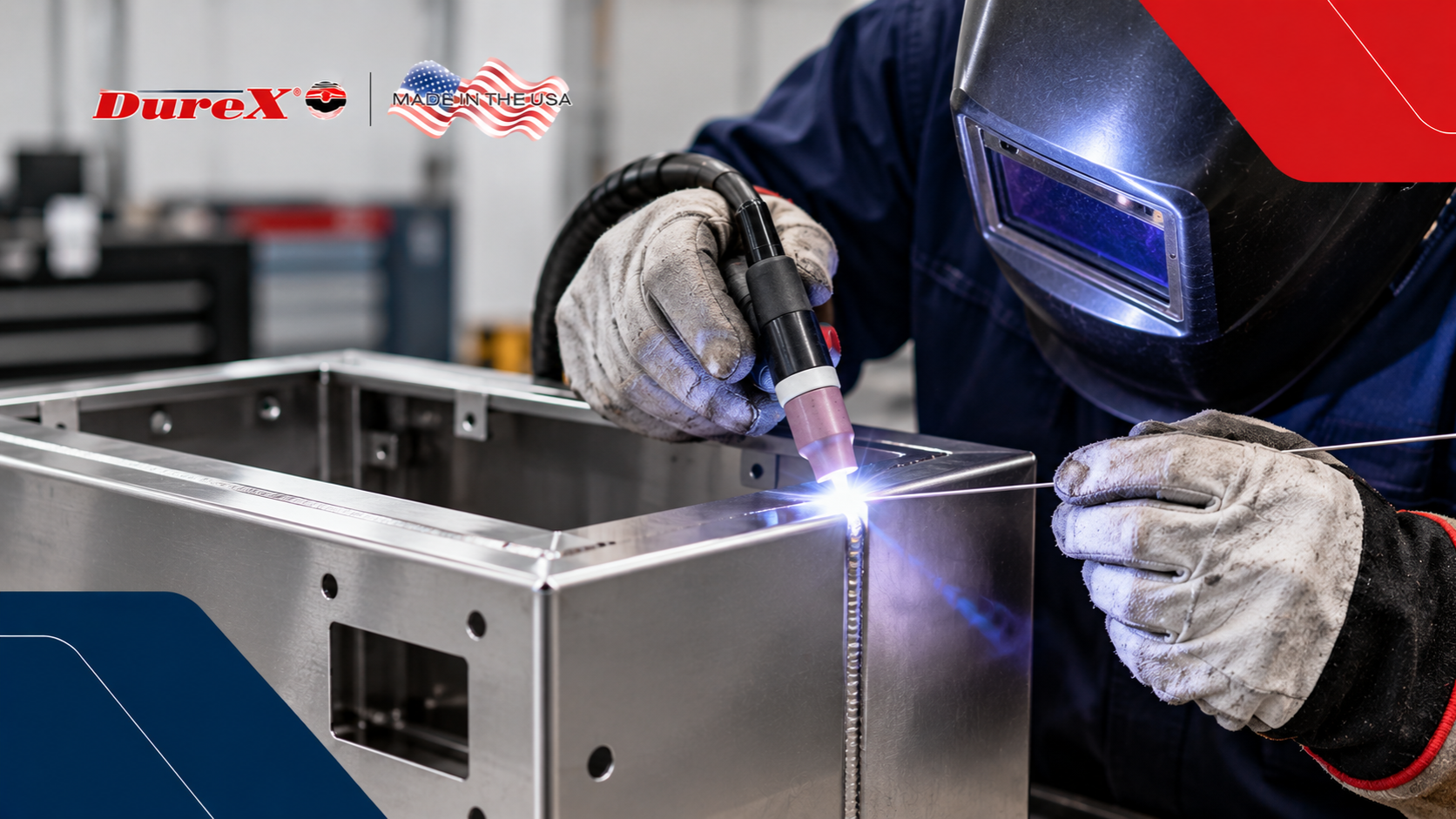
A custom metal enclosure moves through a defined sequence, from the first review of your files to final inspection and shipping. Knowing the steps up front helps you plan approvals, sample reviews, and delivery dates. DureX handles engineering, fabrication, finishing, and assembly at our Union, New Jersey facility, which supports a single-supplier workflow for suitable projects. The steps below show how a typical enclosure project moves from request to delivery.
- Project review and RFQ intake: We gather your drawings, models, quantities, application requirements, and target delivery needs.
- Design-for-manufacturability (DFM) review: We assess bend radii, feature spacing, tolerances, material choice, weld access, hardware placement, and finish requirements.
- Prototype or first-article fabrication: Initial parts or assemblies are produced for fit, function, and approval when the project calls for it.
- Production fabrication: Parts are cut, punched, formed, welded, and fitted with hardware under documented manufacturing controls.
- Finishing and marking: Powder coating, conversion coating, polishing, anodizing, paint, silk screening, or other approved finishes are applied.
- Assembly and inspection: Subassemblies are completed, specified hardware is installed, and the enclosure is inspected to requirements, packaged, and shipped.
The DFM review is where most cost and schedule problems get caught. Adjusting a bend radius, hole spacing, or weld access point on paper is far easier than correcting it after parts are cut.
A first-article or prototype run lets you confirm fit, component access, and appearance before releasing a larger quantity. Our custom sheet metal fabrication process supports both, so the same team that builds your prototype can carry the design into production.
Questions to Ask a Metal Enclosure Manufacturer
Asking the right questions before you award a project helps you compare fabricators on capability instead of price alone. The answers show whether a shop can review your design, build it in-house, and support it from prototype to production. DureX is an ISO 9001:2015 certified custom metal enclosure manufacturer New Jersey buyers can evaluate, providing metal stamping, sheet metal fabrication, CNC machining, welding, powder coating, silk screening, and electromechanical assembly.
- Can you review my CAD files and recommend manufacturability improvements? A good fabricator flags bend, spacing, and weld access issues before cutting begins.
- Which materials and finishes are suitable for my operating environment? The answer should tie to your exposure, temperature, and appearance needs, not a single default.
- Can you make prototypes before full production? A prototype or first article lets you confirm fit and component access first.
- Can you handle low-volume and recurring production quantities? Look for a supplier that can scale without changing processes.
- Are cutting, forming, welding, finishing, and assembly handled in-house? In-house work means fewer handoffs and clearer accountability.
- What quality-system certifications do you maintain? Ask for the specific standard, such as ISO 9001:2015, rather than general quality claims.
- Can you install PEM hardware, hinges, doors, latches, brackets, and internal mounting features? This determines whether the enclosure arrives ready for your components.
- Can you support secondary operations such as powder coating and silk screening? Finishing in-house keeps schedules and appearance consistent.
- How do you control revisions, tolerances, and inspection requirements? Clear revision control prevents parts from being built to outdated drawings.
- Can you manufacture a complete enclosure assembly rather than supplying flat or unfinished parts? Complete assemblies reduce the work left on your side.
Questions like these also help you judge how a supplier communicates, which matters as much as equipment. If you would like to see how we answer them for your project, our team can walk through them when we review your drawings.
You can contact DureX with your files and requirements, and we will respond to each question in the context of your enclosure.
Request a Custom Metal Enclosure Quote
Need a custom metal enclosure built around your equipment, environment, and production requirements? Whether you need a prototype or a production run, DureX Inc. is the custom metal enclosure manufacturer New Jersey customers can contact, with in-house cutting, forming, welding, finishing, and assembly at our Union facility. Our team reviews each project for manufacturability and recommends materials and finishes that suit your application. Send your drawing, CAD file, sample, or project specifications to begin a quote review.
Choose the contact method that works best for you:
- Request a quote: Request a Custom Enclosure Quote
- Call: (908) 688-0800
- Email: info@durexinc.com
For the most accurate first estimate, include your material and thickness, finish, quantity, operating environment, and any required standards. If some details are still open, send what you have and our team will help work through the rest.