

When evaluating precision metal stamping in New Jersey, buyers should look at a supplier’s tooling capability, press capacity, material range, quality systems, and support for downstream processes such as finishing and assembly. For repeatable metal components, a supplier with in-house dies, appropriate press range, and documented quality controls can reduce program risk. Final suitability depends on the part and should be confirmed with engineering.
Selecting a precision metal stamping supplier is not just a question of finding a shop with open press time. The right partner needs to understand your drawing, material requirements, production volumes, tolerances, and inspection expectations before a single die is built. For manufacturers sourcing parts in New Jersey and the broader Tri-State region, these factors directly affect cost, lead time, and quality consistency. A supplier that gets them right early can also help protect your supply chain from avoidable delays later in the program.
DureX Inc. is a contract metal fabrication manufacturer in Union, New Jersey that provides metal stamping services, sheet metal fabrication, CNC machining, finishing, and assembly. The company is ISO 9001:2015 certified and operates more than 50 presses with capacity from 5 to 400 tons.
This guide walks through what to look for in precision metal stamping in New Jersey, from tooling and materials to quality systems and logistics. If you already have a drawing or CAD file ready, you can request a quote at any point.
What Is Precision Metal Stamping?
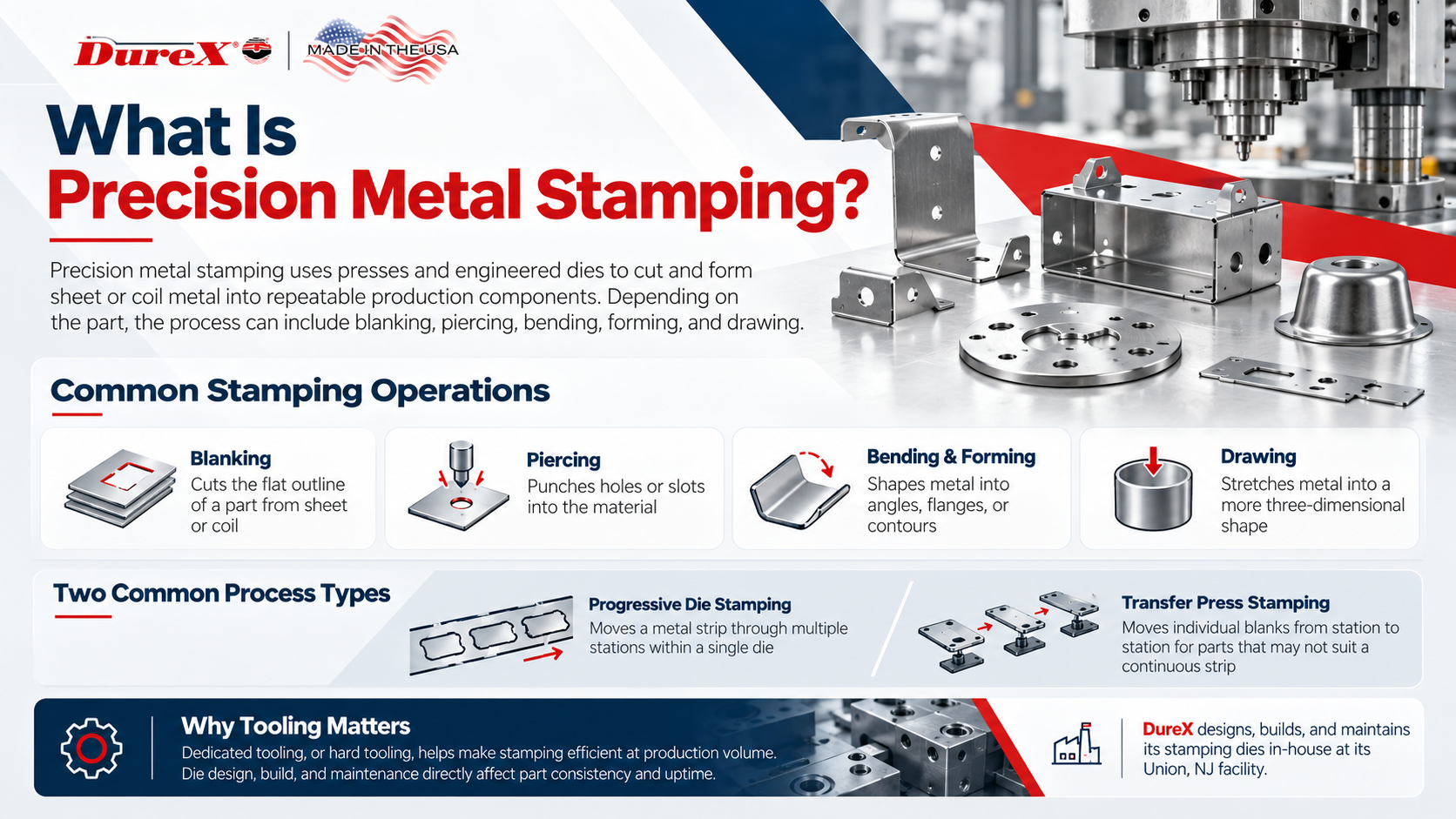
Precision metal stamping is a manufacturing process that uses presses and engineered dies to cut and form sheet or coil metal into repeatable production components. Depending on the part, the process can include blanking, piercing, bending, forming, and drawing. Each die is built for a specific part, which allows the same features to be reproduced consistently across long production runs. For engineers and sourcing teams, that repeatability is the main reason metal stamping is so widely used for recurring metal components.
Common stamping operations include:
- Blanking: cutting the flat outline of a part from sheet or coil
- Piercing: punching holes or slots into the material
- Bending and forming: shaping the metal into angles, flanges, or contours
- Drawing: stretching metal into a more three-dimensional shape
Progressive die stamping moves a metal strip through multiple stations within a single die, with each station performing a different operation. Transfer press stamping moves individual blanks from station to station, which can suit parts that do not work well in a continuous strip.
Dedicated tooling, often called hard tooling, is what makes stamping efficient at production volume. Because the die controls so much of the part’s quality, tool and die design, build, and maintenance have a direct effect on consistency and uptime.
DureX designs, builds, and maintains the dies behind its precision metal stamping in New Jersey at its Union, NJ facility., NJ facility. You can learn more about its metal stamping services or its product engineering support.
When Is Metal Stamping the Right Choice?
Metal stamping is often a strong fit for recurring parts where production volume justifies the cost of dedicated tooling. Once a die is built, it can produce the same features quickly and consistently across long runs. CNC machining can be better suited to prototypes, lower volumes, or parts that need machined geometry that stamping cannot form practically. Comparing both methods early helps avoid committing to the wrong process.
| Evaluation factor | Precision metal stamping | CNC machining |
| Best fit | Repeatable production components and higher-volume programs | Prototypes, lower-volume runs, and parts needing machined geometry |
| Upfront investment | Often requires dedicated tooling | Typically less tooling-intensive |
| Per-part economics | Can improve significantly at production volume | Can be favorable where tooling is not justified |
| Repeatability | Strong when tooling, process control, and inspection are established | Strong when programming and inspection controls are established |
| Deciding factors | Geometry, material, quantity, tolerances, and required operations | Geometry, material, quantity, tolerances, and required operations |
The best process depends on geometry, material, tolerance needs, volume, tooling requirements, and secondary operations. Stamping is not always less expensive, so the comparison should be based on your actual part and forecast.
Because DureX offers both stamping and CNC machining, its team can review which route fits a part before tooling is committed. You can read its guide to CNC machining vs. metal stamping or explore its CNC machining services.
When Is Precision Metal Stamping in New Jersey the Right Choice?
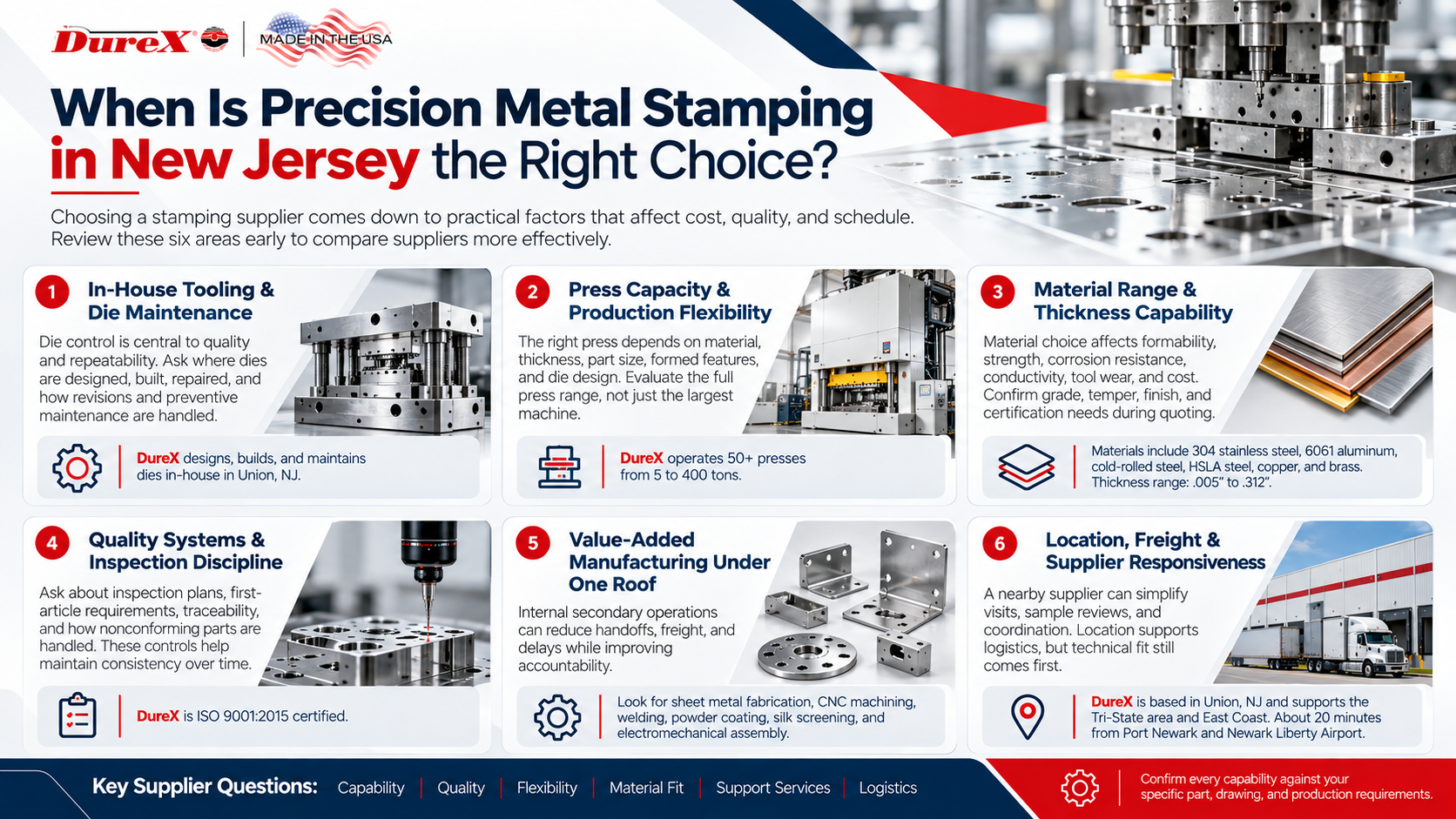
Choosing a stamping supplier comes down to a handful of practical questions that affect cost, quality, and schedule. The areas below are the ones buyers most often evaluate before requesting a quote. Each one should be confirmed against your specific part rather than assumed from a capability list. Asking these questions early helps separate suppliers that can support a full program from those that can only run a single operation.
In-House Tooling and Die Maintenance
For production stampings, the die is central to part quality and repeatability. A supplier that designs, builds, and maintains dies in-house can often respond faster to adjustments, wear, and engineering changes. That control can also reduce the back-and-forth that happens when tooling is managed by an outside toolmaker. Buyers should ask who owns the tooling relationship from first hit through the full production life of the part.
Questions worth asking:
- Where are dies designed, built, and repaired?
- How are preventive maintenance and die repairs scheduled?
- Who controls revisions when the drawing changes?
DureX designs, builds, and maintains its stamping dies in-house at its Union, NJ facility. That gives its team direct oversight of tooling from the start of a program.
Press Capacity and Production Flexibility
Press capacity is more than a single maximum tonnage number. The right press depends on material, thickness, blank size, formed features, and die design. A supplier with a wide range of presses has more flexibility to match each part to the right equipment. Buyers should look at the full range of the fleet, not only the largest machine.
DureX operates more than 50 presses with capacity from 5 to 400 tons. Whether a specific part is a fit still needs to be confirmed by its engineering team.
Material Range and Thickness Capability
Material choice affects formability, tool wear, corrosion resistance, conductivity, strength, and cost. Thickness and part geometry also influence which process and press are appropriate. Confirming material grade, temper, finish, and certification needs during quoting helps prevent surprises once tooling is underway. Suppliers that work across several metals can also help you evaluate alternatives if your first choice is hard to form or source.
DureX lists materials including 304 stainless steel, 6061 aluminum, cold-rolled steel, HSLA steel, copper, and brass. Its stated stamping thickness range is .005 inch to .312 inch.
Quality Systems and Inspection Discipline
A documented quality system gives buyers a baseline for how a supplier controls its processes. Beyond certification, buyers should ask about inspection plans, first-article requirements, material traceability, and how nonconforming parts are handled. These details matter most on recurring programs where consistency over time is the goal. They are also easier to align on during the RFQ stage than after production has started.
DureX is ISO 9001:2015 certified. That certification does not replace part-specific quality planning, but it shows the company operates within a documented quality-management system.
Value-Added Manufacturing Under One Roof
Every extra handoff between suppliers adds coordination work, freight, and potential delay. A supplier that can handle related operations internally may simplify scheduling and accountability. This is especially useful when a stamped part also needs finishing or assembly before it ships. Consolidating these steps can also make it easier to trace a quality issue back to its source.
Related services to look for include:
- Sheet metal fabrication
- CNC machining
- Welding
- Automated powder coating and silk screening (finishing services)
- Electromechanical assembly services
DureX offers all of these alongside stamping. This allows qualified programs to move from tooling to finished product with one manufacturing partner.
Location, Freight, and Supplier Responsiveness
A nearby supplier can make it easier to visit the facility, review samples, and talk through issues in person. Shorter freight lanes may also help with planning, though location alone is never a substitute for technical fit. Buyers should weigh proximity alongside capability, quality, and capacity. A well-located supplier that cannot run your part is still the wrong choice.
DureX is based in Union, NJ and supports customers across New Jersey, the Tri-State area, and the broader East Coast. The facility is approximately 20 minutes from the Port of Newark and Newark Liberty Airport, which may be a useful logistics consideration for some programs.
DureX Precision Metal Stamping Capabilities
DureX supports precision metal stamping programs from its 120,000-square-foot facility in Union, New Jersey. The company combines stamping capacity with engineering, fabrication, machining, finishing, and assembly services under one roof. This allows customers to evaluate more than one production path with a single manufacturing partner. The table below summarizes the capabilities most buyers ask about first.
| Capability | DureX information | Buyer relevance |
| Facility | 120,000-square-foot manufacturing facility in Union, NJ | Established domestic manufacturing footprint |
| Press fleet | More than 50 presses | Flexibility across part types and programs |
| Press capacity | 5 to 400 tons | Range from lighter-gauge to heavier-forming requirements |
| Tooling | In-house die design, build, and maintenance | Tooling control, repair, and production continuity |
| Materials | Stainless steel, aluminum, cold-rolled steel, HSLA steel, copper, brass, and more | Engineering review across common stamped metals |
| Stated thickness range | .005 inch to .312 inch | Helps qualify part and material requirements early |
| Quality system | ISO 9001:2015 certified | Documented quality-management practices |
| Related services | Sheet metal fabrication, CNC machining, welding, powder coating, silk screening, and assembly | Fewer supplier handoffs for qualified programs |
Material options include 304 stainless steel and 6061 aluminum, along with cold-rolled steel, HSLA steel, copper, and brass. Final material suitability depends on the part geometry, thickness, tooling, and production volume.
Stamping Processes
DureX’s public materials identify progressive die stamping and transfer press stamping as part of its stamping offering. Progressive dies move a metal strip through several stations, while transfer presses move individual blanks between stations. Both rely on hard tooling designed for a specific part and production requirement. The right process for your component should be confirmed with DureX engineering during the RFQ stage.
Stamping support can include:
- Progressive die stamping
- Transfer press stamping
- Blanking, piercing, forming, and related secondary operations
- Tooling support from prototype through production
Not every process is available for every part, material, tolerance, or quantity. You can review the full range on the metal stamping services page, or request a quote to start an engineering review.
Supporting Services Around Stamping
Many stamped parts need more than a press operation before they are ready to ship. DureX can support related work such as sheet metal fabrication, CNC machining, and finishing services. Its assembly services can also carry qualified parts through to finished product.
Industries and Applications
Precision stamped components are used wherever manufacturers need repeatable metal parts that meet defined dimensional, material, and performance requirements. Because stamping is built around dedicated tooling, it tends to serve recurring production needs across many sectors. The common thread is a part that must be produced the same way, release after release. DureX works with OEM customers and other manufacturers that rely on this kind of consistency.
Typical stamped components and applications include:
- Brackets, clips, clamps, and fasteners
- Electrical and electronic hardware
- Enclosures, covers, chassis, and cabinet components
- Industrial equipment components
- Appliance and HVAC-related components
- Transportation and automotive-related components
- Custom formed parts and subassemblies
Many of these parts also need secondary work such as machining, finishing, or assembly. DureX can support that work through its CNC machining services, finishing services, and assembly services.
Can DureX Support Regulated or Mission-Critical Parts?
Aerospace, medical, defense, and other specification-intensive programs come with requirements that go well beyond a drawing. These often include specific quality clauses, traceability, documentation, and customer or industry approvals. For that reason, each project should be evaluated individually rather than assumed to fit a general capability list. DureX serves a range of industries, but its team should confirm the scope for any regulated or safety-critical part.
When you submit an RFQ, include drawings, material specifications, quality clauses, inspection requirements, and any traceability or documentation needs. This gives DureX engineering what it needs to review the part against its metal stamping services and quality system.
Information to Include in a Metal Stamping RFQ
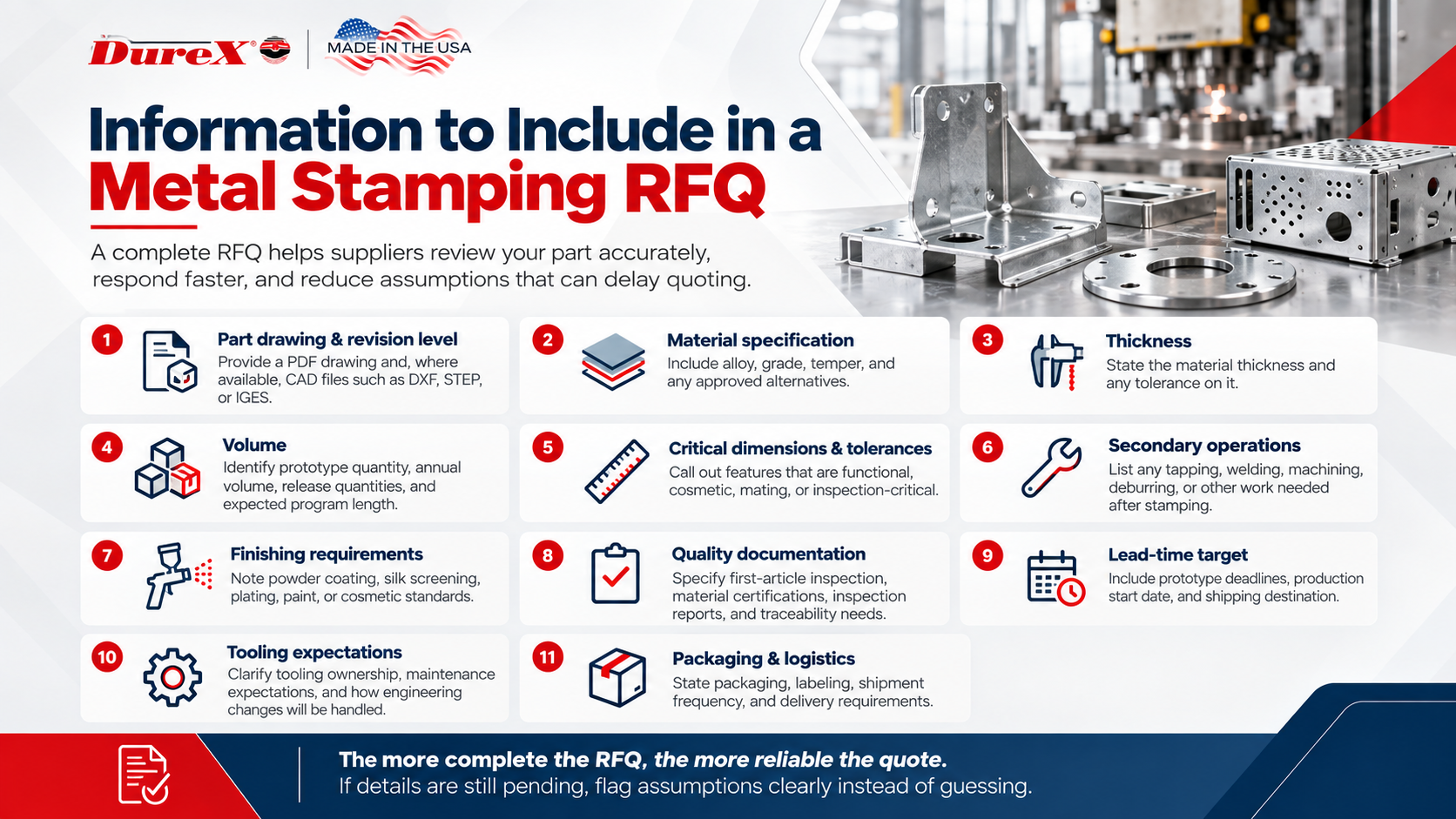
A complete request for quote helps a supplier review your part accurately and respond faster. Incomplete RFQs often lead to follow-up questions, assumptions, and quotes that change once details come out. Gathering the information below before you submit can shorten that process. It also gives the supplier’s engineers what they need to judge whether stamping is the right route for your part.
- Part drawing and revision level: Provide a PDF drawing and, where available, CAD files such as DXF, STEP, or IGES.
- Material specification: Include the alloy, grade, temper, and any approved alternatives.
- Thickness: State the material thickness and any tolerance on it.
- Volume: Identify prototype quantity, annual volume, release quantities, and expected program length.
- Critical dimensions and tolerances: Call out features that are functional, cosmetic, mating, or inspection-critical.
- Secondary operations: List any tapping, welding, machining, deburring, or other work needed after stamping.
- Finishing requirements: Note powder coating, silk screening, plating, paint, or cosmetic standards.
- Quality documentation: Specify first-article inspection, material certifications, inspection reports, and traceability needs.
- Lead-time target: Include prototype deadlines, production start date, and shipping destination.
- Tooling expectations: Clarify tooling ownership, maintenance expectations, and how engineering changes will be handled.
- Packaging and logistics: State packaging, labeling, shipment frequency, and delivery requirements.
The more of these items you can confirm up front, the more reliable the quote will be. If some details are not final, flag them so the supplier can note assumptions instead of guessing.
Why a Detailed RFQ Matters
Tolerances, volumes, and secondary operations all affect tooling design and per-part cost. A change in any one of them after tooling has started can mean rework, delays, or added expense. Reviewing these points together at the quoting stage is far less costly than correcting them later. It also gives engineering the chance to suggest design adjustments that make the part easier to produce.
DureX asks customers to submit a part drawing or CAD file along with material, quantity, required tolerances, and target lead time. Its team can then review the part against its metal stamping services and product engineering support.
Have a drawing, CAD model, or production forecast? Request a quote so DureX can review your part requirements, manufacturing method, and production needs.
Conclusion
Choosing a precision metal stamping partner in New Jersey comes down to how well a supplier can support your specific part from tooling through delivery. The factors that matter most are in-house die capability, press range, material and thickness fit, documented quality systems, and the ability to handle related operations. Weighing these early helps reduce risk, control cost, and keep production on schedule. Each one should be confirmed against your drawing and forecast rather than assumed.
DureX Inc. is a contract metal fabrication manufacturer in Union, New Jersey with more than 50 presses, in-house die design and maintenance, and ISO 9001:2015 certification. Its team can also support sheet metal fabrication, CNC machining, finishing services, and assembly services for qualified programs.
If you have a drawing, CAD file, or production forecast, DureX can review your requirements and help determine the best manufacturing route. Learn more about its metal stamping services, or request a quote when you are ready to start the conversation.