

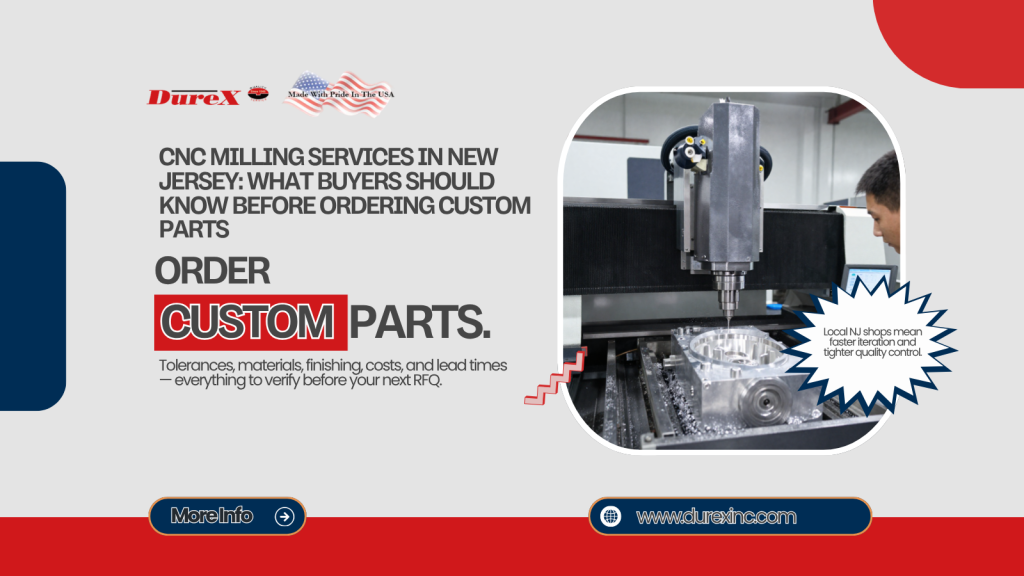
Ordering custom CNC milled parts is a decision that carries real financial and schedule risk if you get it wrong. A vendor’s quoted price rarely tells the full story — tolerances, material sourcing, finishing handoffs, and documentation all shape whether a part actually meets spec on the first run. For procurement managers and design engineers across aerospace, medical, automotive, defense, and industrial sectors, the stakes are even higher when parts feed into regulated assemblies or tight production schedules. This guide breaks down exactly what to verify before you issue an RFQ, so you can compare vendors on capability and risk, not just unit price.
New Jersey offers a distinct advantage for buyers who want to avoid the delays and unpredictability of overseas sourcing. Proximity to the Port of Newark–Elizabeth, a deep pool of skilled machinists, and established industrial corridors mean faster iteration cycles and quicker problem resolution when something needs adjusting mid-run — advantages we cover in more depth in our CNC machining services in New Jersey guide.
This article covers tolerances, materials, finishing options, cost breakdowns, lead times, and a full vendor evaluation checklist. By the end, you’ll have a practical framework for choosing the right CNC milling services in New Jersey.
CNC Capabilities at New Jersey Shops
Not all CNC shops are built the same, and the gap between a general-purpose shop and one equipped for precision work shows up fast once parts hit inspection. Before you commit to a vendor, you need a clear picture of what tolerances they can actually hold in production, not just on a sample part. The same goes for materials — a shop that machines aluminum all day may have little experience with titanium or Inconel, and that inexperience shows up in scrapped tooling and blown schedules. This section breaks down the capability baseline you should expect from serious CNC milling services in New Jersey.
Tolerances & Precision Levels
Standard CNC milling work in New Jersey typically holds tolerances around ±0.001″, which covers the majority of commercial and industrial parts. Tighter tolerances of ±0.0005″ or better are achievable, but usually require 5-axis equipment paired with CMM verification to confirm the part actually meets spec.
It’s worth flagging a common and costly mistake here: over-tolerancing. Specifying tighter tolerances than your application requires drives up cost and lead time for no functional benefit, which is exactly what a good DFM review should catch before the part goes into production.
Materials Available
New Jersey shops with broad capability typically machine a wide range of metals, including 6061-T6 and 7075-T6 aluminum, 303/304/316 stainless steel, titanium Grade 5, brass, copper, and Inconel 625/718. On the plastics side, common options include Delrin, PEEK, nylon, polycarbonate, and UHMW.
Harder materials like titanium and Inconel place real demands on equipment and tooling. This is another area where 5-axis capability matters, since it reduces the repeated setups that accelerate tool wear on difficult alloys.
Finishing & Value-Added Services
Finishing handled in-house removes one of the biggest sources of lead-time risk in a CNC project. Every time a part has to leave the building for anodizing, coating, or plating, you introduce a handoff — and handoffs are where schedules slip and quality control gets murky, which is why DureX keeps finishing in-house alongside machining, stamping, and assembly.
Common in-house finishing options include Type II and Type III anodizing, powder coating, black oxide, passivation, and electroless nickel plating. For regulated industries, documentation should be standard practice, not a special request — First Article Inspection (FAI) reports, CMM inspection data, and material certifications ought to accompany every batch.
Certifications tell you which industries a shop is actually built to serve. ISO 9001 signals a general quality management baseline, AS9100 is aerospace-specific, ISO 13485 applies to medical devices, and ITAR governs defense-related work — so match the certification to your part’s end use, not just the shop’s marketing page.
CNC Milling Costs in New Jersey: Full Breakdown
Price is usually the first thing buyers compare, but a quote number by itself tells you very little without understanding what’s driving it. Two shops can quote wildly different prices for what looks like the same part because of differences in material efficiency, setup complexity, or how many operations the geometry requires. Understanding the actual cost drivers lets you evaluate a quote critically instead of just picking the lowest number and hoping it holds. It also helps you spot red flags — a price that seems too good to be true often means corners are being cut somewhere in tolerance verification or material sourcing.
Key Factors That Drive CNC Cost
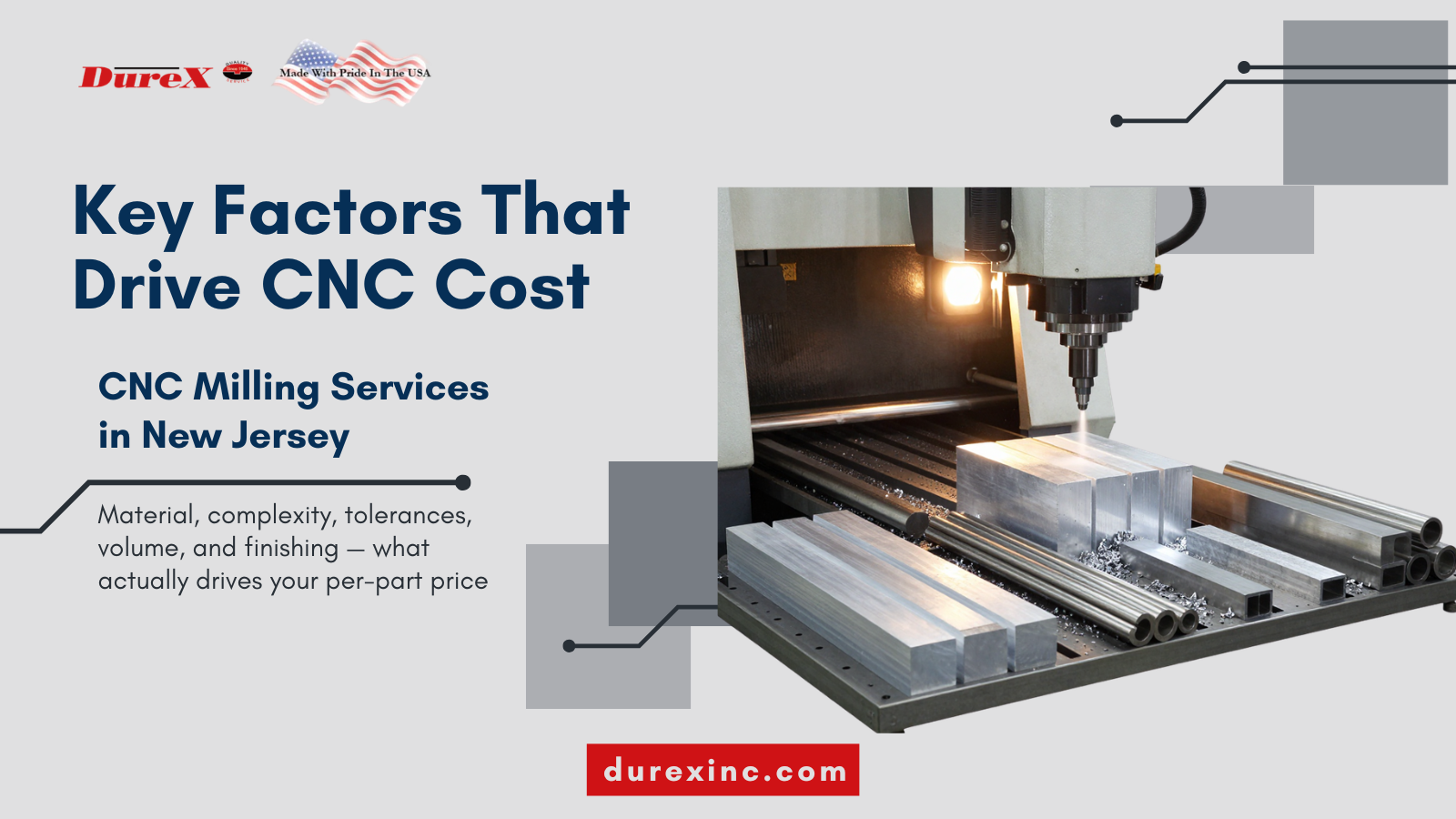
Material choice has an outsized effect on cost, both in raw material price and machinability. Aluminum machines quickly and cheaply, while titanium and Inconel require slower feeds, more tool wear, and more machine time to cut the same volume of material.
Part complexity and the number of setups required also drive cost directly. A part that needs a single 5-axis setup will often cost less overall than one requiring multiple repositionings on a 3-axis machine, even though the 5-axis premium looks higher on paper.
Tighter tolerances mean slower feeds and more inspection time, both of which add to the bill. Volume matters too, since setup and programming costs get spread across more parts as order quantity increases, bringing the per-part price down substantially.
Finishing and post-processing are additional line items worth watching. Anodizing, plating, and coating each add cost, and how transparently a vendor itemizes these charges says a lot about how they’ll handle change orders down the line.
2026 NJ CNC Pricing Estimates
| Order Volume | Estimated Price Per Part |
| Prototype (1–10 units) | $50–$500 |
| Low volume (50–100 units) | $20–$100 |
| Mid volume (100–500 units) | $10–$40 |
| Production (1,000+ units) | $5–$50 |
Estimates assume 6061 aluminum, standard tolerances, and no finishing. Complex geometries, exotic materials, tight tolerances, and finishing requirements will increase these ranges.
The NJ Cost Advantage (Landed Cost)
Comparing a New Jersey quote to an overseas quote on unit price alone misses most of the real cost picture. Tariffs on some imported goods have ranged from 25% to 145% depending on category, and that’s before accounting for freight delays, customs holds, and the cost of reworking parts that arrive out of spec — a full cost comparison is in our CNC machining cost and lead-time guide.
DFM-driven design improvements can save 10–20% on complex programs by catching manufacturability issues before they become expensive machining problems. Local sourcing also means faster response to engineering change orders, which matters a great deal when a design tweak mid-program would otherwise reset an overseas production run entirely.
Lead Times for CNC Milling Projects in New Jersey
Lead time is often the deciding factor when a program is on a tight schedule, and it’s one of the areas where quoted estimates and actual delivery dates can diverge the most. A shop’s stated lead time usually assumes a clean, complete drawing package and no surprises during machining — assumptions that don’t always hold. Knowing realistic timeframes for both prototypes and production runs helps you plan backward from your deadline instead of getting caught off guard. It also gives you a benchmark to push back on if a vendor’s quote seems optimistic.
Prototype Lead Times
Simple prototype parts typically ship in 3–5 business days from a New Jersey shop with available capacity. Complex geometries, 5-axis requirements, tight tolerances, or finishing needs extend that window to 7–15 business days.
Rush turnaround is often available for simple parts, usually in 2–3 days. Expect a premium of 20–40% on top of standard pricing for that expedited service.
Production Run Lead Times
Standard production runs in the 100–1,000 part range typically take 4–6 weeks including finishing. Highly complex parts can push that timeline out to 8 weeks, particularly when multiple finishing operations are involved.
The single biggest risk to a production timeline is a design change mid-run. Any modification after tooling and programming are locked in effectively resets the clock, since the shop has to reprogram and requalify the process before resuming.
How to Shorten Your Lead Time
A few practices consistently shave time off both prototype and production schedules. Submitting complete CAD files along with annotated 2D prints upfront prevents the back-and-forth that stalls a quote before it even starts.
Sticking to standard stock materials like 6061-T6 aluminum or 304 stainless avoids the delays that come with sourcing specialty alloys. Consolidating finishing operations with your machining vendor also removes a handoff step that otherwise adds days to the schedule .DureX’s in-house metal stamping, sheet metal fabrication, CNC machining, assembly, and finishing are set up specifically to eliminate that handoff.
Requesting a DFM review before finalizing your drawing catches manufacturability issues while they’re still cheap to fix. Vendors who build this step into their quoting process tend to deliver more predictable timelines overall.
What to Verify Before Ordering Custom CNC Milled Parts
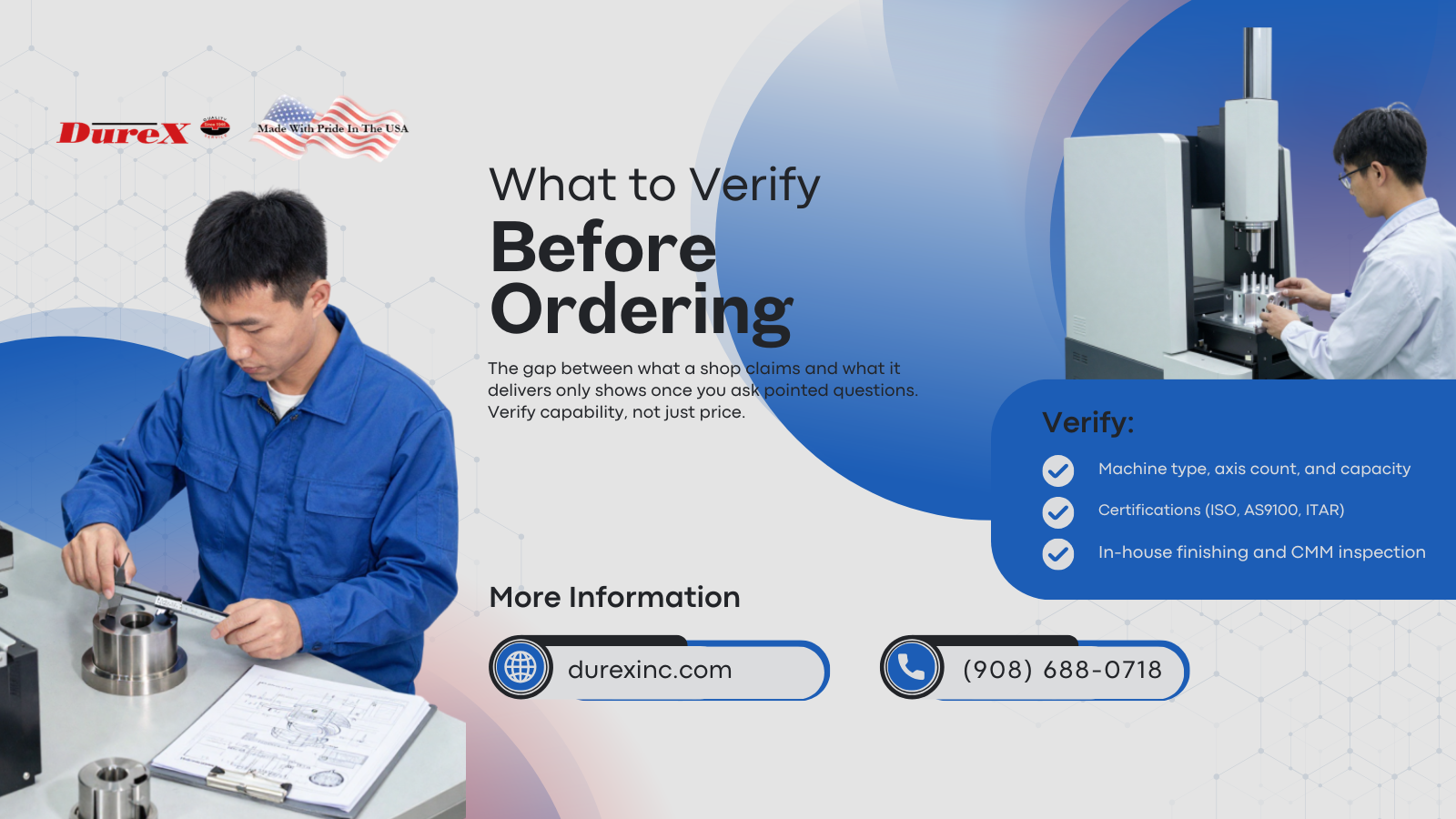
Choosing a CNC vendor based on a quote and a capabilities page is how buyers end up with late deliveries, failed inspections, and expensive rework. The gap between what a shop claims it can do and what it consistently delivers only becomes visible once you ask specific, pointed questions. This section walks through exactly what to verify before you commit — not generic reassurances, but concrete evidence you can request and check. Treat this as the due diligence checklist you run through before selecting CNC milling services in New Jersey, not just a one-time evaluation.
Supplier’s Technical Capabilities
Ask directly about machine type and capacity, including whether they run 3-axis, 4-axis, or 5-axis equipment and what the maximum part travel is on each. A shop that’s vague about its own equipment specs is a shop that hasn’t had to answer this question much, which itself tells you something.
Push further on tolerance capability by asking for examples of recent work at the tightest tolerance your part requires. Material expertise matters just as much — a shop that’s comfortable with aluminum may have limited experience with medical-grade plastics like PEEK or difficult alloys like Inconel, so ask what percentage of their work involves your specific material.
GD&T, DFM, and Traceability
A vendor’s ability to correctly interpret GD&T callouts — particularly True Position and Profile tolerances — directly affects whether the part they deliver matches your design intent. This isn’t a minor technical detail; misreading a GD&T callout is one of the most common causes of parts that fail final inspection despite “meeting print.”
Ask whether the shop provides DFM feedback proactively or only when something goes wrong. A vendor that flags manufacturability issues before quoting is signaling that they understand your part, not just your price target.
Traceability should be non-negotiable for regulated industries. Confirm that material certifications and inspection reports are generated per batch, and ask whether CMM equipment is actually on the shop floor or outsourced to a third party.
Documentation, Compliance, and Communication
Request a process flow chart showing the CNC steps and QC checkpoints your part will pass through. This gives you visibility into where inspection actually happens in the workflow, not just a claim that “quality is checked.”
Verify that certifications are current, not expired — ask for certificate numbers and expiration dates directly. Communication quality is a leading indicator of how a vendor will handle problems: a shop that turns around quotes with DFM notes within 24 hours is telling you how they’ll respond when something needs fixing mid-production.
Production Capacity, Lead Times, and Finishing
Confirm the shop’s actual production capacity against your volume needs, not just their stated lead time for a single prototype. Ask specifically whether finishing is done in-house or subcontracted, since every subcontracted step adds a handoff and a point of potential delay.
When comparing prices across vendors, factor in rework and scrap rates, shipping efficiency, and long-term reliability — not just the number on the quote. The cheapest quote upfront can easily become the most expensive part once rework and missed deadlines are factored in.
How to Choose the Right CNC Milling Services in New Jersey
By this point you’ve asked the right questions, but you still need a way to weigh the answers against each other. Not every factor carries equal weight for every project — a defense contractor cares about ITAR compliance in a way a commercial automotive supplier doesn’t, and a low-volume prototype run has different priorities than a 5,000-part production order. This section pulls everything together into a checklist you can actually use during vendor selection, along with a framework for deciding when local New Jersey capacity is worth the premium over an online machining service.
Vendor Evaluation Checklist
For a closer look at how these factors play out in practice, see our breakdown of CNC machining capabilities, costs, and lead times in New Jersey.
- Certifications matched to your industry (ISO 9001, AS9100, ISO 13485, ITAR)
- Quoting speed and DFM feedback delivered within 24 hours
- Machine capability verified with recent tolerance data, not just spec sheets
- In-house finishing list covering anodizing, passivation, powder coating, and similar processes
- Inspection capability confirmed on-site, including CMM and FAI reporting
- Industry references — ask for 2–3 contacts in your specific vertical
- Pricing transparency with itemized setup, material, rush, and inspection costs
Local NJ Shops vs. Online Machining Services
Online machining services make sense for simple, non-critical parts with standard tolerances and no special material requirements. They’re fast to quote and often cheaper for straightforward jobs where any competent shop can deliver an acceptable result.
Local New Jersey shops earn their premium on tight tolerances, exotic materials, ongoing production programs, and projects that need rapid iteration cycles. When a design changes mid-program or a batch fails inspection, having a vendor you can reach — or visit — the same day changes how quickly the problem gets solved.
For production relationships involving blanket orders or vendor-managed inventory, local shops are the practical default. The relationship itself becomes part of the value, since a vendor who understands your parts and your quality bar over multiple orders catches problems that a one-off transactional vendor never will.
Ready to Order With Confidence?
Choosing CNC milling services in New Jersey shouldn’t come down to guesswork on tolerances, timelines, or hidden finishing handoffs.. The right vendor gives you clear answers on capability, documentation, and lead time before you ever commit to a purchase order.
Ready to quote your next CNC milled part? Submit your CAD file and drawing for a DFM-reviewed estimate within 24 hours.
Want to see the shop floor before you commit? Schedule a capabilities walk-through with our engineering team to review machine capacity, finishing options, and inspection processes firsthand.